

How to Prepare Your Home for the 2026 Hurricane Season
As the shadow of Hurricane Helene still lingers, the storms of 2025 are already on the horizon. Hurricane Helene, a

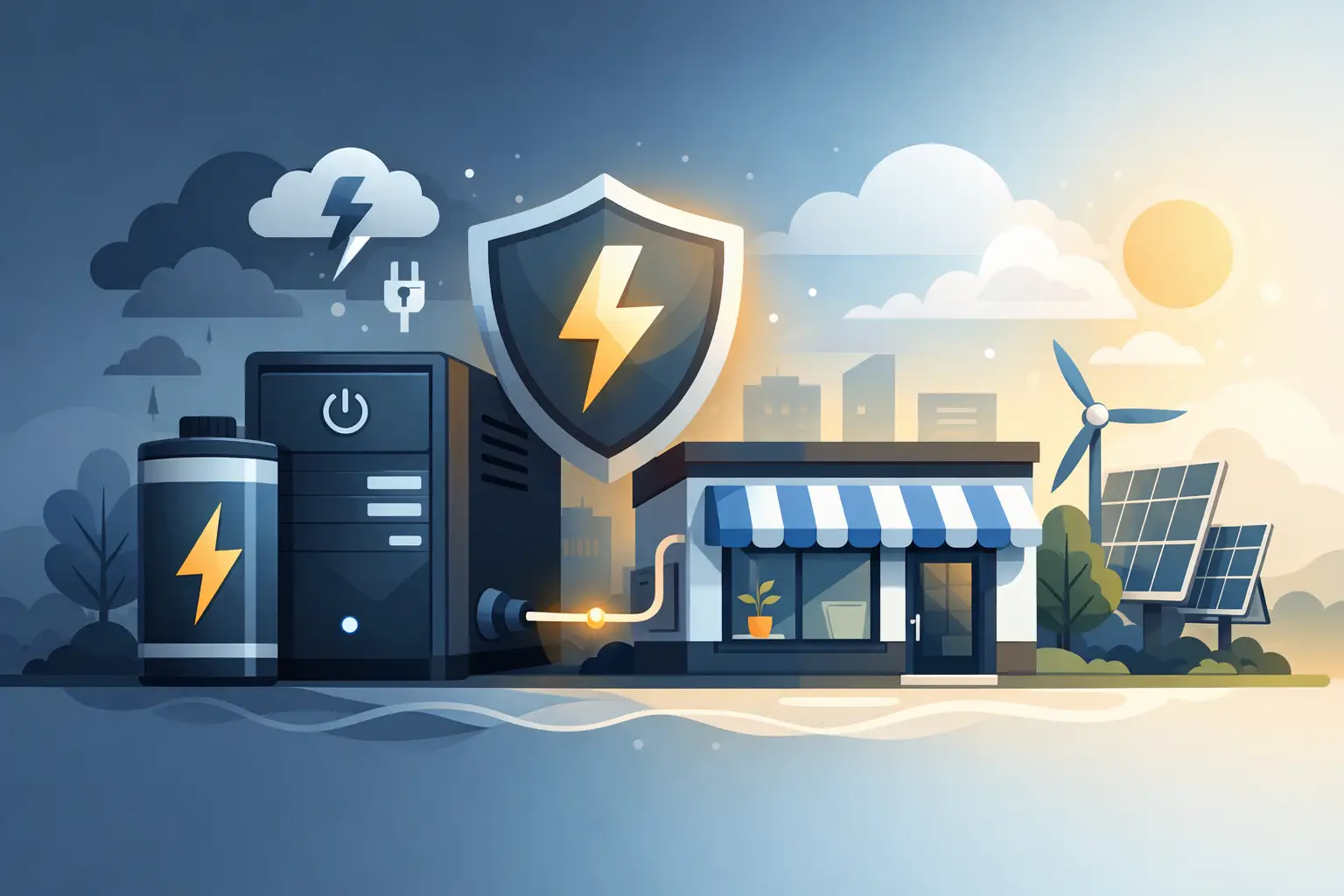
When the power drops in the middle of a card payment, a refrigeration cycle, or a busy afternoon, the cost is immediate. Battery backup for small business is not just about keeping the lights on. It is about protecting revenue, customer trust, and the daily systems that let your business operate without chaos.
For many small businesses, outages are no longer rare disruptions. They are part of normal planning, especially in coastal and storm-prone areas where grid instability, heat, and severe weather put extra pressure on equipment. A backup plan that works in real conditions can mean the difference between a short interruption and a full day of lost business.
Generators still have a place, but they are not always the right first line of defense. They need fuel, ventilation, and regular maintenance. They are also noisy, which can be a poor fit for retail spaces, offices, clinics, and customer-facing environments. Battery systems solve a different problem. They provide immediate backup power with no startup delay, no fumes, and far less day-to-day hassle.
That matters most for equipment that cannot afford even a brief interruption. Point-of-sale systems, routers, modems, security cameras, computers, phones, and certain medical or food storage equipment all depend on consistent power. Even a short outage can corrupt files, interrupt transactions, or create a poor customer experience that lingers long after the power returns.
Battery backup also gives small businesses more control. Instead of treating every outage like an emergency, you can decide what stays on, what shuts down, and how long your core operations can continue. That is a practical advantage, not a luxury.
One of the most common mistakes is trying to back up everything at once. That usually leads to overspending or choosing a system that is too small for the job. A better approach is to identify your critical loads first.
In most small businesses, those loads fall into a few clear groups. The first is revenue-critical equipment, such as checkout systems, payment terminals, and internet hardware. The second is operational essentials, like office computers, printers used for orders or labels, security systems, and communication devices. The third is protection loads, including refrigeration, medical storage, or other equipment where downtime creates spoilage, compliance issues, or safety concerns.
Once you know what absolutely must stay powered, sizing becomes more realistic. A small office may only need to support networking, laptops, phones, and one printer for several hours. A café may need a more serious setup because refrigeration and payment systems both matter. A salon may care more about lighting, scheduling, and payment continuity than heavy equipment.
This is where planning beats guesswork. Look at the wattage of each essential device, estimate how many hours of runtime you need, and build around that real-world number. If your goal is four hours of continuity for core systems, the solution will be very different than if you need to carry refrigeration overnight.
There is no one-size-fits-all answer. It depends on your business type, your outage pattern, and how much of your operation must stay online.
Portable power stations are a smart fit for many small businesses because they are simple to deploy and easy to move. They work well for routers, POS systems, laptops, small displays, phones, cameras, and other low-to-medium draw equipment. They are especially useful if you need flexible backup that can move between locations, front counter areas, home offices, pop-up events, or temporary workspaces.
A larger battery backup system makes more sense when you need longer runtime, higher output, or support for more demanding circuits. If your business depends on refrigeration, multiple workstations, dedicated lighting, or a server closet, a whole-home or whole-site style battery approach may be the better investment. It is also the stronger option if outages are frequent enough that backup power is part of normal operations rather than an occasional safety net.
The trade-off is cost and complexity. Portable systems are faster to adopt and easier for many owners to start using right away. Larger installed systems offer more coverage and a cleaner long-term solution, but they require more planning. The right choice is the one that matches your actual risk.
A lot of business owners shop by the biggest number they see. That can be misleading. Capacity matters, but only in relation to what you are powering and for how long.
A battery may look substantial on paper, yet drain quickly if you connect equipment with heating elements, compressors, or high startup surges. Refrigerators, freezers, ice makers, and some commercial appliances can be especially demanding. By contrast, networking gear, LED lighting, laptops, and payment terminals are relatively light loads and can run much longer on the same battery capacity.
That is why runtime should drive the decision. Ask a simple question first: during an outage, what do we need to keep running for one hour, four hours, or all day? Then match the battery system to that target. In many cases, a staged backup plan is more effective than a single oversized purchase. You may use battery power for instant continuity and short outages, then pair it with solar charging or another backup source for longer events.
For businesses in sunny, outage-prone areas, battery backup becomes much more valuable when paired with solar. A battery alone gives stored energy. Solar gives you a way to recharge during extended disruptions and reduce your dependence on the grid between outages.
This matters most after storms, when fuel supply can be uncertain and outage timelines are hard to predict. A solar-compatible battery system can keep critical loads supported longer without the noise and maintenance of a generator-only approach. It also helps lower operating costs over time if you use the system regularly rather than leaving it idle for emergencies only.
That said, solar is not magic. Panel size, weather, battery capacity, and load demand all affect how much support you get. If your business needs to run heavy equipment nonstop, solar charging alone may not carry the full load. But for communications, checkout, lighting, office electronics, and selected appliances, it can significantly extend resilience.
Backup equipment should be chosen for the place where it will actually operate, not a perfect showroom environment. Heat, humidity, salt air, and storm exposure can shorten the life of poorly matched systems.
For businesses in coastal climates, durability matters as much as output. You want equipment that can handle warm conditions, store safely, and perform consistently when the grid is unstable. Good battery management, reliable inverter performance, and practical portability all matter. So does support. If you are buying backup power for business continuity, warranty coverage and product guidance are part of the value, not an afterthought.
Ease of use matters too. In a real outage, nobody wants to decode a complicated setup. Clear displays, simple charging options, and straightforward connection points make a difference when staff need to act quickly.
The cheapest system is often the one that fails your business at the worst time. At the same time, buying more capacity than you need is not efficient either. The better way to budget is to compare the cost of backup power with the cost of downtime.
If one outage can stop sales, spoil inventory, interrupt bookings, or force staff home early, the financial case becomes clearer. Even modest continuity can protect far more value than the purchase price suggests. A battery system that keeps internet, checkout, phones, and refrigeration running through common outages may pay for itself faster than expected.
For many businesses, the practical path is to start with critical loads and expand over time. That gives you protection now while leaving room to build a more complete energy independence plan later.
The best battery backup for small business use is the one that fits your real operating needs, not the one with the flashiest specs. Start with what must stay on, decide how long you need it powered, and choose a system built for the conditions your business faces.
If your business deals with storms, grid instability, or rising pressure to stay available no matter what, backup power should be treated like essential infrastructure. SOL242 focuses on solutions designed for exactly that kind of reality, where reliability is not optional and preparedness protects more than equipment.
A good backup plan gives you something every small business needs when the grid fails – time to keep serving customers, protect what matters, and make decisions without panic.
As the shadow of Hurricane Helene still lingers, the storms of 2025 are already on the horizon. Hurricane Helene, a
The Bahamas: turquoise waters, sun-kissed beaches, gentle trade winds, and a relaxed pace of life. It’s one of the most

The Bahamas is blessed with sunshine almost all year round, making it one of the best places on earth to
All rights reserved sol1242.com © 2025


