

How to Prepare Your Home for the 2026 Hurricane Season
As the shadow of Hurricane Helene still lingers, the storms of 2025 are already on the horizon. Hurricane Helene, a

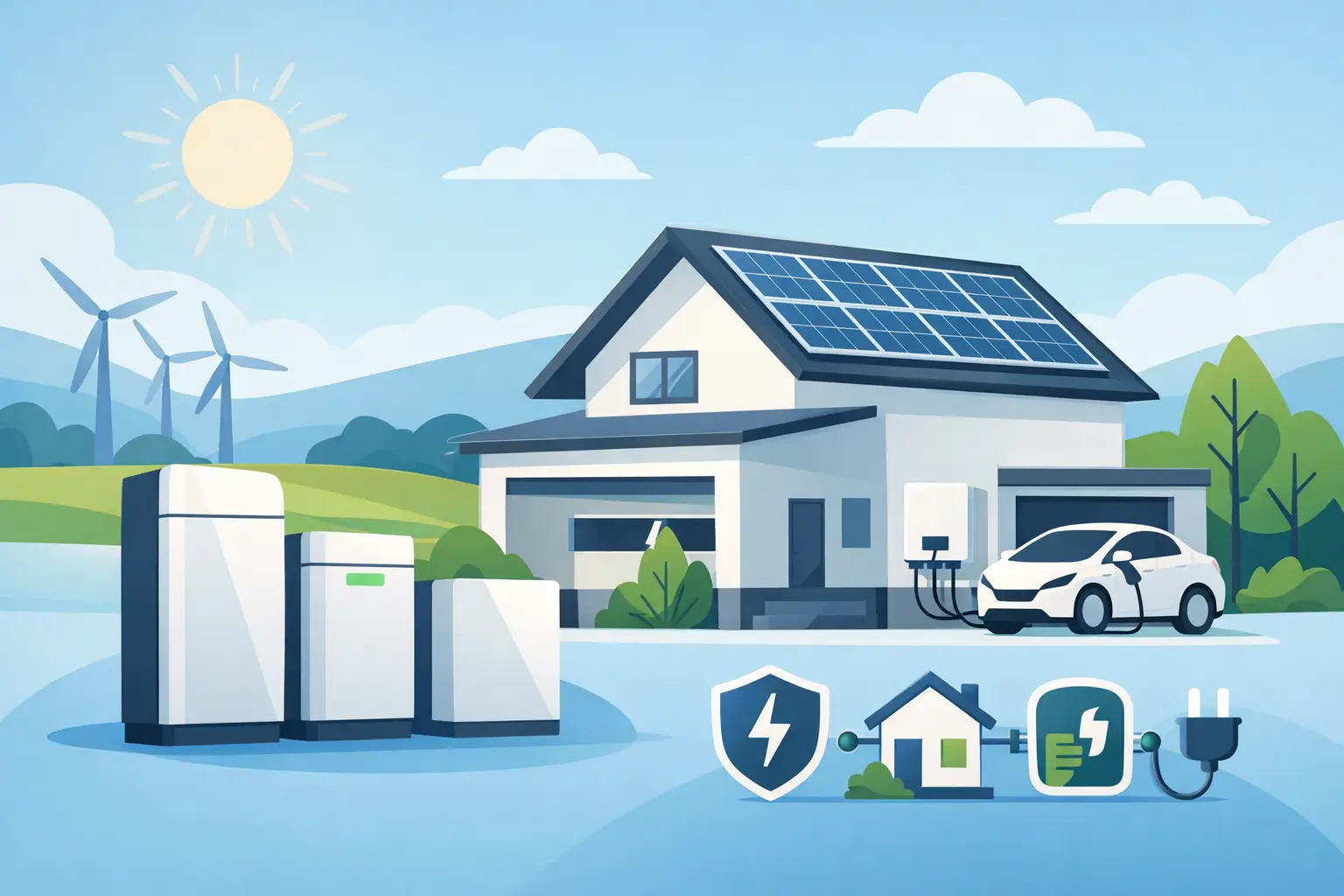
When the power goes out at 2 a.m. and the fridge, Wi-Fi, lights, and security system all drop at once, battery backup stops being a nice idea and becomes a household priority. The best home battery backup systems are the ones that keep essential loads running without guesswork, hold up in heat and humidity, and make sense for how your home actually uses power.
For homeowners in storm-prone and outage-prone areas, the right system is not always the biggest or most expensive. It is the one sized correctly, installed properly, and matched to your daily habits, backup goals, and local conditions. If you are comparing options before hurricane season or trying to cut dependence on the grid year-round, here is what separates a smart purchase from an expensive mismatch.
A good home battery system does three jobs well. First, it stores enough usable energy to carry the loads you care about. Second, it delivers enough power at one time to start and run those loads. Third, it charges in a way that fits your setup, whether that means solar, grid charging, or both.
That sounds simple, but this is where many buyers get tripped up. Battery capacity, usually measured in kilowatt-hours, tells you how long a system can run. Power output, measured in kilowatts, tells you what it can run at the same time. A battery may have plenty of stored energy but still struggle if your air conditioner, pump, or refrigerator all try to start together.
The best systems also account for real-world conditions. In coastal climates, heat, salt air, and humidity are not small details. They affect performance, placement, lifespan, and maintenance. That is why weather-aware product selection matters just as much as specs on paper.
If your goal is to keep most or all of the house operating during an outage, whole-home lithium battery systems are the strongest option. These are typically wall-mounted or floor-mounted systems designed to pair with a home inverter and, often, a solar array.
They work best for larger homes, families with frequent outages, and property owners who want backup power to feel automatic. The biggest advantage is scale. You can often start with one battery and add more later. The trade-off is cost. This route usually requires professional design and installation, and it makes the most sense when you want permanent protection rather than occasional emergency backup.
Modular systems are a practical middle ground for households that want flexibility. Instead of committing to a large battery bank all at once, you can build capacity over time. That is useful if your budget is tight now but your backup needs may grow later.
These systems are especially attractive for homeowners who want to start with essentials like lights, refrigeration, fans, and internet, then expand to larger circuits. The main advantage is control. The downside is that not every modular platform expands as smoothly as advertised, so compatibility and future availability matter.
Not every home needs a permanently installed battery wall. Portable solar generator systems with high-capacity batteries can cover critical loads during shorter outages and are often easier to deploy quickly. They are popular with renters, smaller homes, and anyone who wants emergency power without a major installation project.
For essential appliances, communications, medical devices, and basic comfort, a serious portable power station can be enough. Just be realistic about limits. A solar generator may run a refrigerator and some lights well, but central air conditioning, electric water heating, and whole-home panels are another category entirely.
Hybrid systems combine the strengths of solar and storage. During the day, solar can power loads directly and recharge the battery. At night or during an outage, the battery carries the load. For homeowners trying to reduce fuel dependence, this is one of the most resilient setups available.
This option makes particular sense in sunny coastal regions where outages can last beyond a single evening. The trade-off is that system design matters more. Panel size, battery size, inverter capacity, and load planning all have to work together. If one part is undersized, the whole system feels weaker than it should.
For many households, the smartest move is not whole-home backup but essential-load backup. That means selecting the circuits that matter most, usually refrigeration, lights, internet, security, fans, a few outlets, and possibly a water pump.
This keeps costs down while still protecting comfort and safety. It is often the best value for homeowners who experience regular outages but do not want to spend for whole-house coverage. The key is honesty. If you expect a compact system to behave like a full-house generator replacement, you will be disappointed.
Some homes need backup for larger loads such as well pumps, multiple refrigerators, workshop equipment, or parts of an HVAC system. In that case, power output matters just as much as battery capacity. High-output systems are built to handle stronger surge demands and heavier continuous loads.
These systems can be excellent for larger households and small businesses, but they require tighter planning. A battery with strong output usually costs more, and you may also need more storage than expected if those heavier loads run for long periods.
If you live off-grid full-time or want serious independence from unstable utility service, stackable off-grid systems offer long-term control. These setups are built to manage daily cycling, renewable charging, and larger battery banks.
They are ideal for cabins, remote homes, and properties where power continuity is non-negotiable. They are less ideal for someone who simply wants a quick outage solution with minimal setup. Off-grid capability is powerful, but it comes with more planning, more components, and more responsibility.
Start with what must stay on. Not what would be nice to keep on, but what truly matters in an outage. For most households, that means the refrigerator, freezer, lights, fans, communications, and possibly pumps or medical equipment. Once you know those loads, you can estimate both required power and runtime.
Then think about outage length. If your utility interruptions usually last a few hours, a smaller system may be enough. If storms can leave you without power for a day or more, battery capacity and solar recharging become much more important.
Your climate should shape the decision too. In hot, humid environments, equipment placement and enclosure quality matter. A battery system installed in a poorly ventilated space may not age well. Products designed for demanding conditions are worth the attention, especially when reliability is the whole point.
Budget matters, but so does expansion. A cheaper system that cannot grow may cost more in the long run if your needs change. On the other hand, paying for whole-home backup when you only need essential circuits can tie up money better spent on solar input, surge protection, or added battery capacity.
This is not an either-or debate for every household, but it helps to be clear about strengths. Batteries are quiet, instant, low-maintenance, and safe for indoor-adjacent installation when designed for that purpose. They are excellent for overnight outages, everyday load shifting, and pairing with solar.
Generators still have an edge for very long outages and heavy continuous loads, especially if fuel is available. But fuel availability is exactly where the equation gets complicated after storms. Batteries do not need refueling, and when paired with solar, they offer a more independent recovery plan.
For many homeowners, the best answer is based on tolerance for noise, maintenance, refueling, and power interruptions. If you want automatic, quiet backup for essential loads, batteries are often the better fit. If you need to run large HVAC loads for days without enough solar input, a generator may still play a role.
The biggest mistake is shopping by battery size alone. A large number in kilowatt-hours looks reassuring, but it does not tell you whether the system can handle startup surges or power enough circuits at once.
Another mistake is underestimating installation details. Transfer switches, inverter compatibility, panel configuration, and charging strategy all affect the final result. Even a strong battery can feel disappointing if the system around it is poorly matched.
Some buyers also ignore where and how the equipment will live. In island conditions, durability is not a bonus feature. It is part of the buying decision. If your system will face heat, moisture, or salt exposure, that should be factored in early, not after the purchase.
A smart battery backup purchase feels boring in the best way. When the grid drops, your essentials stay on, your family stays comfortable, and you are not running extension cords in the dark. That kind of reliability comes from matching the system to the home, not chasing the biggest headline spec.
If you are comparing products now, focus on real backup goals, expansion potential, charging options, and how the system will perform in your environment. For homeowners who need dependable outage protection and practical energy independence, SOL242’s approach is the right one to follow – choose equipment built for real conditions, not just showroom promises.
The best backup system is the one you trust before the next storm shows up, not the one you wish you had after it passes.
As the shadow of Hurricane Helene still lingers, the storms of 2025 are already on the horizon. Hurricane Helene, a
The Bahamas: turquoise waters, sun-kissed beaches, gentle trade winds, and a relaxed pace of life. It’s one of the most

The Bahamas is blessed with sunshine almost all year round, making it one of the best places on earth to
All rights reserved sol1242.com © 2025


