

Solar Backup for Small Business That Holds Up
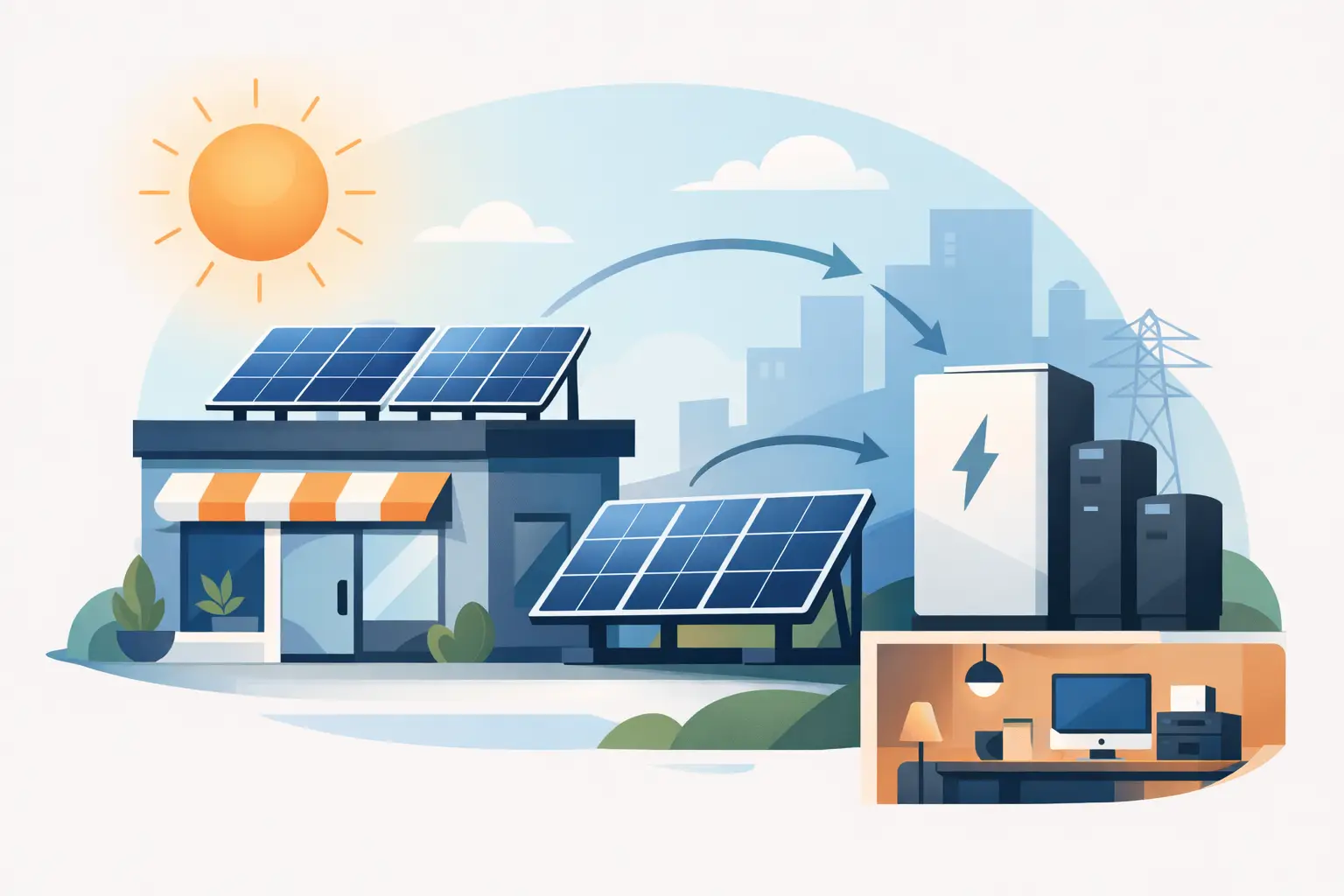
When the power drops in the middle of a sales day, small problems turn expensive fast. Card readers stop, freezers warm up, routers go dark, and staff end up waiting instead of working. That is why solar backup for small business is no longer a nice extra for storm season. For many owners, it is basic protection for revenue, customer trust, and day-to-day continuity.
For small businesses in coastal and storm-prone areas, backup power needs to do more than switch on during an emergency. It has to handle heat, humidity, long outages, and the reality that some equipment matters more than others. A bakery has different priorities than a clinic, and a retail shop has different risks than a small office. The right system starts with what you must keep running, not with the biggest battery you can afford.
What solar backup for small business really means
A practical solar backup system usually combines three parts: battery storage, an inverter, and solar panels. The battery stores energy, the inverter makes that stored energy usable for business equipment, and the panels help recharge the system when the grid is down or when you want to reduce utility use during normal operation.
That setup can be small and focused, or broad enough to support a large share of your business. Some owners only want to protect internet service, point-of-sale equipment, lights, and security systems. Others need refrigeration, fans, medical equipment, communication systems, or a few critical outlets across the property. There is no single best answer because power needs, outage patterns, and budgets vary.
What matters is choosing backup power based on business continuity. If a short outage costs you a few minutes, a portable power station may be enough. If an outage can spoil inventory, stop bookings, or shut down customer service for hours, a larger solar generator or home and business battery backup system makes more sense.
Start with your critical load, not your full building
Many small business owners make the same mistake at the beginning. They try to power everything. That usually drives the price up and leads to a system that feels out of reach.
A better approach is to identify your critical load. Ask a simple question: if the grid failed for eight hours, what absolutely needs to stay on? For a small shop, that may be the router, modem, checkout system, lights at the counter, and one fan. For a restaurant or café, it may include refrigeration and payment systems. For a property manager, it may be gate access, emergency lighting, communications, and security cameras.
Once you know those essentials, sizing gets easier. You can estimate how many watts those devices use and how long they need to run. That gives you a clearer picture of whether you need a compact portable power station, a mid-size solar generator, or a larger battery backup system tied to dedicated circuits.
This approach also keeps your investment focused on what protects revenue first. You can always expand later.
When a portable setup is enough
Not every business needs a whole-building solution. For many small operations, a portable power station paired with portable solar panels covers the most urgent outages without the complexity of a permanent install.
This works especially well for mobile businesses, small offices, kiosks, pop-up retail, and service-based businesses that rely on communication devices, laptops, payment terminals, and lighting. It also makes sense as a first layer of backup power. If the outage is short, you keep operating. If the outage stretches on, the solar panels help recharge the battery during daylight hours.
Portable systems also have an advantage in hurricane prep. They can be moved, stored, and repositioned more easily than fixed equipment. That flexibility matters when conditions change quickly.
The trade-off is capacity. Portable setups are excellent for electronics and selected appliances, but heavy loads such as large air conditioning systems, commercial kitchen equipment, and high-demand machinery usually require a much larger system.
When a larger battery backup system makes more sense
If your business depends on refrigeration, multiple workstations, essential lighting, or operational continuity through longer outages, a larger battery system is usually the stronger choice. These systems can support dedicated circuits and provide a more structured backup plan instead of a device-by-device workaround.
This is where solar becomes even more valuable. A battery alone gives you stored power, but solar panels add the ability to recover during a prolonged grid failure. That can be a major advantage in places where outage restoration may take time after severe weather.
For businesses in the Bahamas and similar coastal environments, durability matters as much as capacity. Equipment exposed to salt air, heat, and humidity needs to be chosen with local conditions in mind. Backup power that performs well in a mild climate may not hold up the same way on an island property or near the coast.
The real business case: protection, not just savings
Some owners look at solar backup mainly through the lens of utility savings. That can be part of the value, but for small businesses the stronger case is often loss prevention.
If a one-day outage stops sales, damages inventory, disrupts bookings, or sends customers elsewhere, the cost adds up quickly. In that context, backup power is less about chasing perfect energy efficiency and more about protecting operations when the grid is unreliable.
That does not mean every system pays off the same way. A business with frequent outages and sensitive inventory may see fast value from backup power. A business with rare outages may focus more on preparedness and continuity than direct return. Both are valid. The right decision depends on how expensive downtime is for your specific operation.
How to choose the right solar backup for small business
The best system is the one that matches your real operating risk. Start by looking at four things: your must-run equipment, the length of typical outages, your available space for solar charging, and whether you need portability or a more permanent setup.
Battery chemistry matters too. Many modern systems use lithium iron phosphate batteries, which are known for long cycle life and better thermal stability. For business use, that often makes more sense than cheaper options that may wear out sooner or handle harsh conditions less well.
You should also think about recharging speed and output options. During an outage, it helps to have enough AC outlets, USB ports, and charging flexibility to support the mix of equipment your business uses. If your operations depend on internet and communications, fast and dependable recharging can be just as important as the total battery size.
And do not overlook physical practicality. Can the unit be moved by one person? Can it be stored safely before a storm? Does it fit the way your team actually works? A backup system only helps if it is easy to deploy when needed.
Common mistakes that lead to disappointment
The most common problem is undersizing. Business owners often estimate based on one or two devices and forget startup surges, long operating hours, or extra items that become critical during an outage. Refrigeration, pumps, and some tools can draw more power at startup than expected.
Another mistake is buying for rare peak demand instead of normal emergency use. If your goal is to keep core operations going, focus on the loads that protect revenue and safety. Trying to run every nonessential device can turn a smart backup plan into an oversized purchase.
The third mistake is treating solar panels as optional when outage duration is uncertain. If blackouts are brief, battery-only may be enough. If outages can last through the day or beyond, solar charging adds resilience that a plug-in-only setup cannot match.
Why preparedness should feel practical
Backup power is easy to postpone when the weather is clear and business is normal. The pressure usually shows up later, when shelves are stocked, customers are waiting, and the grid fails at exactly the wrong time.
That is why the strongest backup plans are practical, not complicated. They are built around your most important loads, your real outage patterns, and equipment that can hold up under local conditions. For many business owners, that starts with one dependable system and grows over time.
SOL242 focuses on backup power built for real-world coastal conditions because reliability is not just about having electricity. It is about keeping your business open, protected, and ready when the grid is not.
If you are considering solar backup, start with the equipment your business cannot afford to lose for even a few hours. That is usually where the smartest decision becomes obvious.


