
How to Prepare Your Home for the 2026 Hurricane Season
As the shadow of Hurricane Helene still lingers, the storms of 2025 are already on the horizon. Hurricane Helene, a

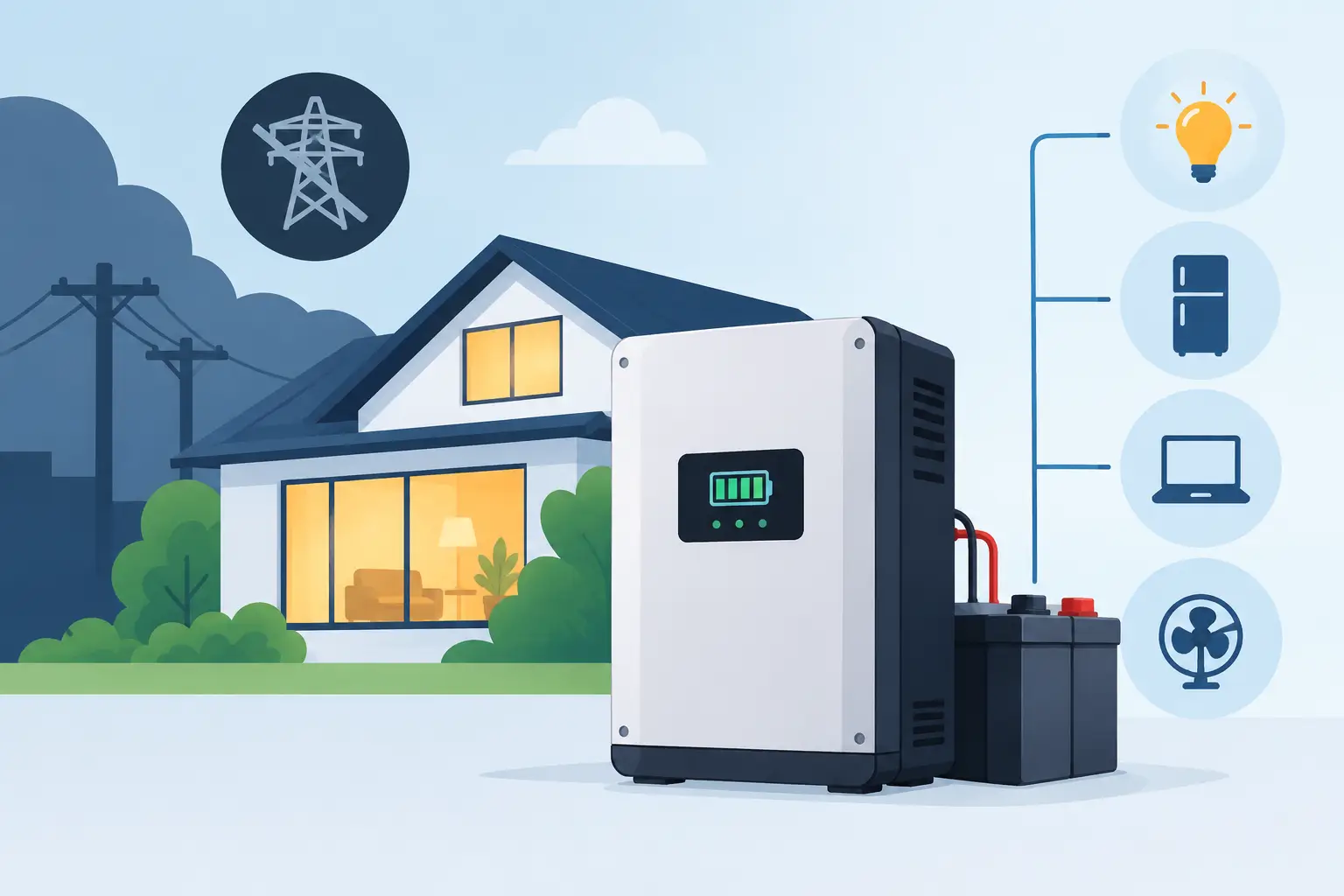
A refrigerator full of food, a working fan, charged phones, and a few lights can make an outage manageable. But only if your inverter can carry the load when the grid drops. When you are asking what size inverter is needed, the answer is not based on the size of your home. It comes down to the specific appliances you need running, their starting surge, and how long you need backup power to last.
For hurricane preparedness, island properties, and homes that experience regular outages, choosing too small an inverter can leave essential equipment off when it matters most. Choosing far too large can add unnecessary cost and drain batteries faster through higher idle consumption. The right setup is sized around your real priorities.
An inverter converts battery power into the AC electricity used by standard household appliances. Its power rating is measured in watts. To size one correctly, add up the watts of every device you plan to operate at the same time, then allow room for appliances that need extra power to start.
Start with your critical-load plan. During a short outage, that might mean a refrigerator, internet router, lights, phone chargers, fans, and a television. For a longer event, you may add a chest freezer, medical equipment, a small water pump, or a window air conditioner. A whole-house backup plan is a different category from a critical-load plan and usually requires professional system design.
Here are common running-power ranges to help you estimate. Actual labels on your equipment should always be the final authority.
| Appliance or device | Typical running watts | | — | —: | | LED light bulb | 8-15 W | | Phone charger | 5-25 W | | Wi-Fi router | 10-25 W | | Laptop | 50-100 W | | Television | 60-200 W | | Box or pedestal fan | 40-100 W | | Refrigerator | 100-300 W | | Chest freezer | 100-400 W | | Microwave | 800-1,500 W | | Coffee maker | 800-1,500 W | | Small window AC | 500-1,500 W |
Suppose your priority loads are a 200-watt refrigerator, 80 watts of lights, a 20-watt router, a 75-watt fan, a 100-watt television, and 50 watts of chargers. Your running load is 525 watts. A 1,000-watt inverter may cover that set of loads, but it may not start the refrigerator reliably if other appliances are already running. In that case, a 1,500-watt pure sine wave inverter is often a more comfortable fit.
A good rule is to choose an inverter with a continuous rating at least 20% to 30% above your expected simultaneous running watts. That safety margin handles normal variations and reduces the chance of constantly operating the unit at its limit.
Motors and compressors briefly draw more electricity when they start. Refrigerators, freezers, pumps, power tools, and air conditioners are the usual troublemakers. This is called surge power, starting watts, or peak watts.
A refrigerator may run at 150 watts but require 800 to 1,200 watts for a few seconds as its compressor starts. A pump can demand several times its normal running wattage. Your inverter needs enough surge capacity to handle that moment without shutting down.
Check both ratings before you buy. A quality inverter might be rated for 2,000 continuous watts and 4,000 surge watts. The continuous rating tells you what it can supply over time. The surge rating tells you how much starting demand it can absorb briefly.
If your plan includes an air conditioner, do not guess. Check the unit label or manual for running amps, locked-rotor amps, or starting watts. Standard AC units can push a modest battery system beyond its limits quickly. A soft starter may reduce the startup demand of certain compatible air conditioners, but it does not eliminate the unit’s ongoing energy use.
For basic outage coverage, a 500- to 1,000-watt inverter can run lights, device charging, a router, and small electronics. It is a practical range for a compact portable power station used for communication and comfort.
For refrigerator backup plus lights, fans, internet, and electronics, 1,500 to 2,000 watts is often the useful middle ground. This range gives many households flexibility without committing to a full-home system.
For a larger critical-load setup with a refrigerator, freezer, microwave, water pump, or multiple rooms of essential power, look at 2,000 to 3,000 watts or more. You still need to manage what runs at the same time. A 3,000-watt inverter does not make every appliance in the house available without limits.
For central air conditioning, electric ranges, clothes dryers, electric water heaters, and whole-home coverage, the system needs a load calculation. These appliances can require large inverter capacity, substantial battery storage, specialized wiring, and often a properly designed solar charging system. This is where a home battery backup system and a licensed electrician are the sensible path.
A large inverter does not create energy. It only determines how much power can be delivered at one time. Battery capacity determines how long that power is available.
Battery storage is usually measured in watt-hours or kilowatt-hours. A 1,000-watt load running for one hour uses roughly 1,000 watt-hours, or 1 kWh. Real-world runtime is somewhat lower after accounting for inverter losses, battery limits, temperature, and the fact that appliances such as refrigerators cycle on and off.
For example, a 2 kWh battery could theoretically support a 500-watt average load for about four hours. If your refrigerator cycles and your actual average is closer to 250 watts, the same battery may last much longer. That is why measuring your intended loads is more useful than relying on appliance categories alone.
During a multi-day outage, solar input changes the equation. Portable solar panels can recharge a compatible power station during daylight, while a fixed solar and battery system can support more substantial daily needs. In the Bahamas and other sunny coastal areas, solar can be a major advantage after storms, but panel output still depends on weather, shading, panel orientation, and safe installation.
For home backup, a pure sine wave inverter is the safer choice. It supplies power that closely matches utility electricity and is well suited to refrigerators, fans, modern televisions, computers, medical devices, chargers, and sensitive electronics.
Modified sine wave inverters may cost less, but they can make motors run hotter or noisier and may not work well with some appliances. When the goal is dependable backup power rather than occasional tool use, pure sine wave equipment is worth prioritizing.
Also check the inverter’s input voltage. A smaller setup may use a 12V battery system, while larger systems often use 24V or 48V battery banks to reduce current and improve efficiency. High-power 12V systems can require very heavy cables, correctly sized fuses, and careful installation. Battery and inverter voltage must match.
The first mistake is adding every appliance in the home instead of deciding what is essential. A focused backup plan costs less and provides longer runtime. Keep refrigeration, communications, lighting, ventilation, and medical needs at the center of the plan.
The second is ignoring surge demand. A system that looks adequate on paper may shut down when the refrigerator compressor or pump starts. Leave capacity for that initial pull.
The third is overlooking charging. If a battery takes two days to recharge from limited solar input, it may not provide the independence you expect after an extended outage. Match battery capacity to a realistic solar charging plan, generator charging option, or grid recharge window.
Finally, never connect an inverter to household wiring through a regular wall outlet. Backfeeding can injure utility workers, damage equipment, and create a fire hazard. Use a properly installed transfer switch or an approved inlet and have fixed home connections completed by a qualified electrician.
The best inverter is the one that keeps your most important loads operating without wasting money on capacity you will never use. Write down the appliances that protect food, comfort, communication, business continuity, and safety. Add their running watts, account for the largest starting surge, then choose a pure sine wave inverter with sensible headroom.
For storm season, keep the plan simple enough that everyone in the household can use it: know which outlets power the essentials, keep batteries charged, and test the system before the forecast turns serious. Reliable backup power is not about running everything. It is about keeping life moving when the grid cannot.
As the shadow of Hurricane Helene still lingers, the storms of 2025 are already on the horizon. Hurricane Helene, a
The Bahamas: turquoise waters, sun-kissed beaches, gentle trade winds, and a relaxed pace of life. It’s one of the most

The Bahamas is blessed with sunshine almost all year round, making it one of the best places on earth to
All rights reserved sol1242.com © 2025


