

What Size Power Station for a Refrigerator?
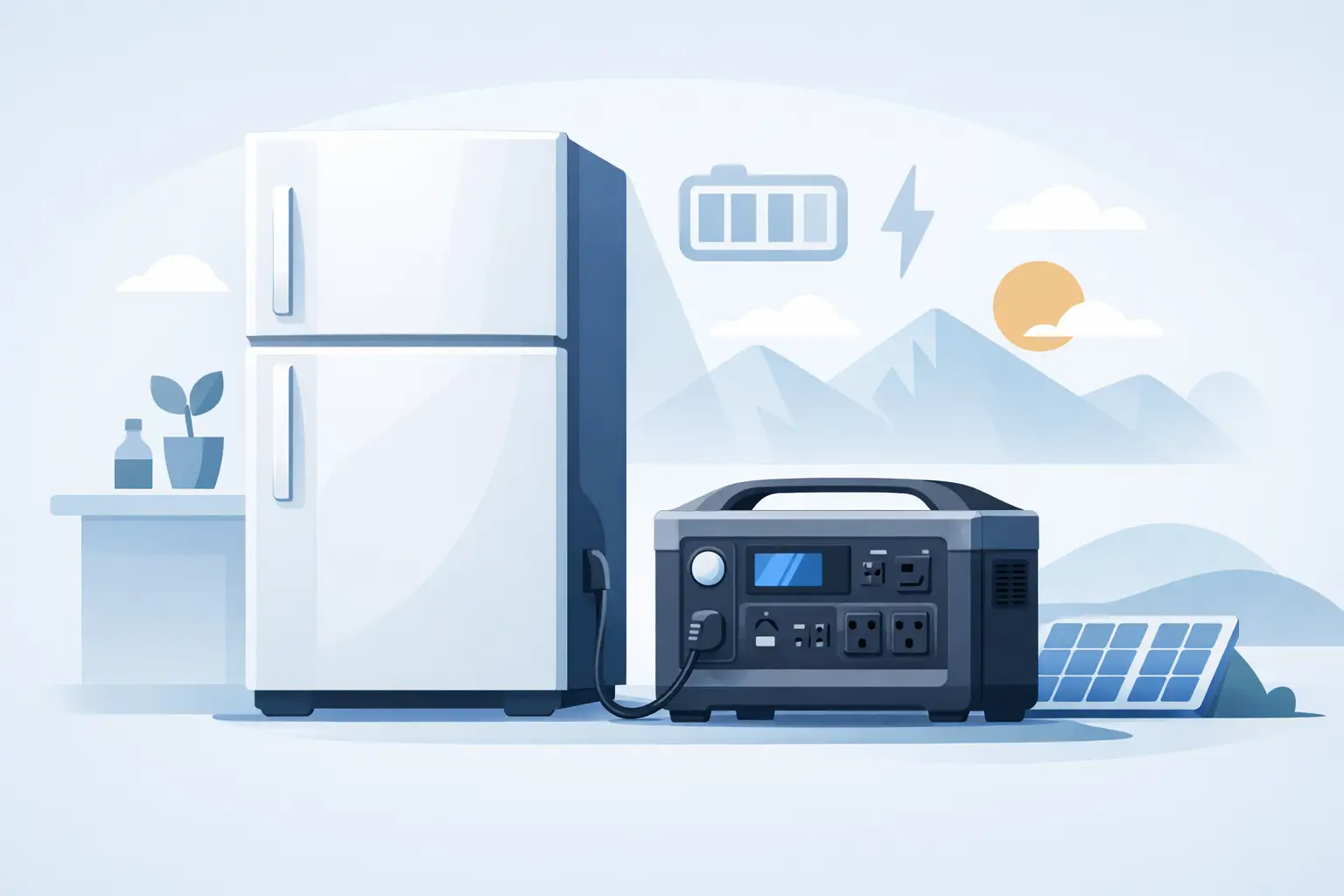
A refrigerator does not use a huge amount of power every second, but it does ask for a strong burst of electricity when the compressor starts. That is why the answer to what size power station refrigerator backup needs is rarely as simple as matching the number on the energy label. If you want dependable cold storage during an outage, you need enough output for startup surge and enough battery capacity to keep food safe for the hours ahead.
What size power station refrigerator backup actually needs
For most full-size home refrigerators, a power station in the 1000W to 2000W range with at least 1000Wh of battery capacity is a practical starting point. Many standard refrigerators run at roughly 100W to 250W once operating, but startup surge can jump much higher, often into the 600W to 1200W range and sometimes more depending on the model and age.
That means a small power station may appear large enough on paper but still fail when the compressor kicks on. The safer approach is to size for both running watts and surge watts, then choose battery capacity based on how long you need refrigeration during an outage.
If you are protecting food during storm season, this matters. A brief outage may only require a moderate battery. A long utility interruption after severe weather calls for more storage or a solar recharge plan, especially in hot coastal conditions where refrigerators cycle more often.
The two numbers that matter most
Running watts
Running watts are the power your refrigerator uses during normal operation. Many modern units fall between 100W and 250W, while compact fridges may use less and older or larger models may use more. If you can find the refrigerator label or manual, look for rated watts or amps.
If the label shows amps instead of watts, multiply amps by voltage. In the US, most refrigerators use 120V power. So a refrigerator rated at 2 amps would use about 240 watts.
Startup surge
Startup surge is the brief spike in power needed to start the compressor. This is the number people miss. A refrigerator that runs at 180W may need 700W or more for a second or two at startup.
Your power station inverter must handle that surge without shutting down. If you are buying backup power for a refrigerator, compressor surge is just as important as battery size.
Battery capacity decides how long it will run
Once you know the power station can start the refrigerator, the next question is runtime. Battery capacity is measured in watt-hours, or Wh. That number tells you how much stored energy the power station holds.
A simple example helps. If your refrigerator averages 150W while running, a 1000Wh power station will not run it for a full 6.6 hours straight because refrigerators cycle on and off, and there are inverter losses. Real-world performance is usually lower than the raw math suggests.
In practice, many refrigerators do not run continuously. They cycle as needed to maintain temperature. That can work in your favor, but runtime still depends on room temperature, how often the door opens, the age of the appliance, and how cold you keep it.
As a rough planning guide, a 1000Wh unit may keep a typical efficient refrigerator going for several hours to around half a day in favorable conditions. A 1500Wh to 2000Wh unit gives you a stronger buffer. If you need overnight protection or outage coverage that stretches well beyond that, larger battery capacity or solar charging becomes the smarter move.
A practical sizing guide by refrigerator type
Mini fridge or dorm fridge
A compact refrigerator often runs at lower wattage and has a lower startup surge. In many cases, a 500W to 1000W power station with 500Wh to 1000Wh of storage can work well. This is the easiest refrigerator category to support.
Standard kitchen refrigerator
This is where most households should be careful. A safe target is usually a 1000W to 2000W power station with at least 1000Wh of battery capacity. If outage protection is the priority, stepping up to 1500Wh or more gives you more breathing room.
Large fridge or fridge-freezer
Larger units, older compressors, and refrigerators with ice makers or extra features can demand more. In that case, look toward 1800W to 2400W output and 1500Wh to 2500Wh or more in battery storage. If the unit is mission-critical, it is worth sizing up instead of trying to get by with the bare minimum.
Why minimum sizing often leads to disappointment
The cheapest option that can technically power a refrigerator is not always the right one. If your power station is barely above the surge requirement, it may struggle as battery percentage drops or when heat increases demand. If battery capacity is too small, you may only get a short window of protection before recharge becomes urgent.
That matters even more in places where outages may last for many hours or longer after a storm. For island households and coastal properties, backup power should not be planned around best-case conditions. It should be planned around the day the grid is down, the weather is hot, and you need cold storage to stay reliable.
How to calculate what size power station refrigerator use requires
Start by checking your refrigerator label for watts or amps. If you only see amps, multiply by 120V. Then estimate startup surge at 3 to 5 times running wattage unless the manufacturer provides a better number.
Next, decide how long you want backup power to last. If your refrigerator averages 150W and runs roughly one-third of the time, daily energy use might land near 1200Wh depending on conditions. That gives you a better picture than looking at running watts alone.
Then leave room for losses. Power stations are not 100 percent efficient, and real use is never perfectly steady. A little margin now is better than spoiled groceries later.
When solar charging changes the answer
If you are pairing the power station with portable solar panels, you may not need one massive battery for every situation. Solar can extend runtime during daylight and help cover multi-day outages. For homes, cabins, RVs, and off-grid setups, that can be the difference between short-term backup and real energy independence.
Still, solar does not erase the need for proper inverter sizing. Your power station must still handle compressor startup. Solar mainly helps replenish the battery, not replace the output requirement.
For hurricane season or prolonged outages, a power station plus solar is often the more resilient setup. You get immediate battery backup at night and recovery potential once the sun is back.
Common mistakes to avoid
One mistake is sizing only for running watts. Another is assuming every refrigerator uses the same amount of energy. A compact efficient unit and an older side-by-side model can behave very differently.
It is also easy to overlook ambient heat. In warmer climates, refrigerators cycle more often, which increases daily energy use. Opening the door frequently during an outage adds even more strain. If food preservation is a priority, choose enough capacity to handle real conditions, not just ideal ones.
Finally, do not forget that you may want to power more than one appliance. If the same power station also needs to run lights, a router, phones, fans, or a freezer, that extra load should be part of your sizing decision from the start.
So, what size should you buy?
If you want the shortest answer to what size power station refrigerator backup needs, here it is. For a mini fridge, start around 500W to 1000W output and 500Wh to 1000Wh capacity. For most standard refrigerators, look for 1000W to 2000W output and at least 1000Wh, with 1500Wh or more being a stronger choice for outage protection. For larger or older refrigerators, move into the 1800W to 2400W range and consider 1500Wh to 2500Wh or more.
If you are preparing for storm outages, not just weekend convenience, it usually pays to size up one step. A little extra inverter headroom and battery reserve buys more than runtime. It buys confidence when the power goes out and the refrigerator needs to keep doing its job.
For households that depend on reliable backup power in heat, humidity, and uncertain grid conditions, choosing the right power station is less about gadgets and more about keeping daily life protected. Buy for the outage you expect, but also for the one you hope never arrives.


