Posted on — Leave a comment

Beginner’s Guide to Solar Backup Power
Beginner’s Guide to Solar Backup Power

The lights go out, the fridge warms up, the Wi-Fi drops, and suddenly power is not an abstract utility bill issue. It is food, communication, security, and peace of mind. That is exactly why a beginners guide to solar backup should start with one simple truth: the right system is not the biggest one. It is the one that keeps your essential loads running when the grid does not.

For many homeowners and small business owners, solar backup sounds more complicated than it really is. Panels, batteries, inverters, watt-hours, surge loads – it can feel technical fast. But the buying decision gets much easier once you separate backup power into a few practical categories and match them to what you actually need during an outage.

What solar backup really means

Solar backup is a power system that stores energy in a battery and can recharge from solar panels. When utility power fails, the battery supplies electricity to devices, appliances, or parts of your building. In some setups, you plug devices directly into a portable power station. In others, a home battery backup system is connected to selected circuits in your electrical panel.

The key difference between solar backup and a standard gas generator is how it operates. A battery system is quiet, requires far less routine maintenance, and can be used indoors when designed for indoor use. Solar also gives you a path to recharge without fuel deliveries, which matters when roads are blocked, fuel is scarce, or outages stretch longer than expected.

That does not mean solar backup replaces every generator in every situation. If you need to run central air, heavy machinery, or a whole large house for days with high consumption, battery capacity and solar input need to be planned carefully. In some cases, a battery system works best for essentials rather than every load you own.

A beginner’s guide to solar backup starts with your outage plan

Before you compare products, decide what “power during an outage” actually means for your household or business. For some people, it means phones charged, lights on, and the router working. For others, it means keeping a refrigerator cold, running a cash register, powering security equipment, or supporting medical devices.

This is where many first-time buyers go wrong. They shop by marketing terms instead of outage priorities. A better approach is to picture the first 24 hours without grid power. What must stay on? What would be nice to have? What can wait?

A small apartment, a single room, and a retail storefront will all need different backup strategies. Even in the same home, hurricane season planning may look different from everyday outage planning. If your goal is emergency resilience, essentials come first. If your goal is more daily energy independence, capacity becomes more important.

The three system types most beginners should know

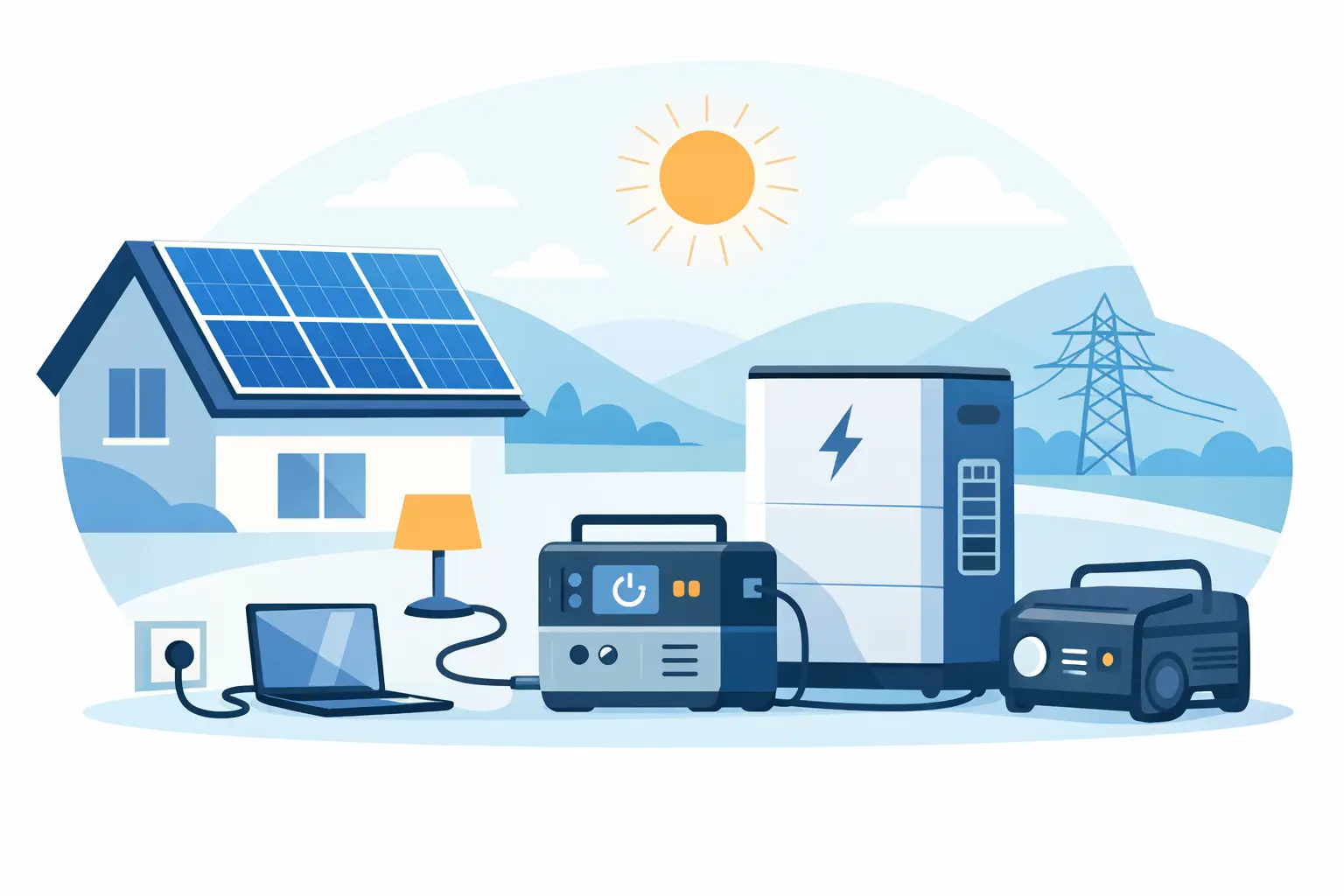
The simplest place to start is with portable power stations. These are all-in-one battery units with built-in outlets, USB ports, and charging inputs. They are a strong fit for charging phones, laptops, lights, fans, routers, CPAP machines, and in some cases a small fridge or television. They are easy to move, easy to store, and ideal for renters, travel, boats, and quick emergency use.

The next level is a solar generator setup. In practical terms, this usually means a portable power station paired with portable solar panels. The battery handles nighttime and immediate backup. The panels help recharge it during daylight. For outage preparation, this gives you much more staying power than a battery alone.

Then there are home battery backup systems. These are better for people who want selected circuits or larger appliances supported automatically or semi-automatically. They take more planning and a larger budget, but they offer a more complete backup solution for homes and some small commercial spaces.

How to size a solar backup system without guessing

Sizing comes down to two numbers: how much power something needs right now, and how much energy it uses over time. Power is measured in watts. Energy is usually measured in watt-hours.

If a device uses 100 watts and you run it for 5 hours, that is 500 watt-hours. A 1,000 watt-hour battery could run that device for about 10 hours in perfect conditions, though real-world performance will be lower because of inverter losses and battery reserve limits.

This matters because many beginners focus only on battery size and ignore output limits. A battery may have enough stored energy to run an appliance for hours, but if the inverter cannot handle the startup surge, the appliance will not run. Refrigerators, pumps, and some power tools often need extra startup power.

A practical first step is to list your essential devices, note their wattage, and estimate how many hours you need each one during an outage. If you are unsure, check the appliance label or manual. Once you total those numbers, add some buffer. Real outages are rarely convenient, and your needs usually grow once the power is actually out.

Solar panels matter more than many beginners expect

A battery alone is backup. A battery with solar is resilience. That distinction matters when outages last more than a few hours.

If you buy a power station but do not pair it with enough solar input, you may still run out of usable energy during an extended disruption. The battery gets you through the night or the first phase of the outage. The solar panels are what help you recover the next day.

For buyers in coastal and island environments, panel durability matters too. Heat, humidity, salt exposure, and storm conditions are not minor details. They affect long-term reliability. That is why it makes sense to choose equipment designed for harsh conditions, not just attractive specs on a product page.

Portable panels are great for flexible use and emergency deployment. Fixed panels make more sense when you want a more permanent backup setup. The best option depends on whether you need mobility, speed of setup, or ongoing home support.

What to power first during an outage

In most homes, the first priority is communication and preservation. That means phones, lights, internet equipment, refrigeration, and in hot climates, fans. For some households it also means medical devices, security systems, or basic cooking capability.

For small businesses, the list may shift toward internet, point-of-sale equipment, security cameras, lights, and refrigeration if inventory depends on it. Property managers may prioritize gates, exterior lighting, communication tools, and water-related systems.

Air conditioning is where expectations need to be realistic. Small portable units may be possible with larger systems, but central AC often requires a much more substantial battery and inverter setup. If cooling is a priority, many people do better planning around fans, one cooled room, or selective use rather than whole-property cooling during every outage.

Common mistakes first-time buyers make

The most common mistake is underestimating energy use. People often assume a compact battery will run large appliances much longer than it actually can. The second mistake is buying too small on solar input, which leaves them unable to recharge fast enough between outages or during cloudy weather.

Another issue is ignoring environment. Equipment used in the Bahamas, coastal Florida, or other hot and humid regions has to deal with more than sunlight. Salt air, storm risk, and high temperatures can shorten product life if the system is not suited to those conditions.

Some buyers also overbuy. If your real need is communications, lights, and a fan, a full home system may not be the smartest first purchase. Starting with a well-sized portable setup can be more affordable, easier to deploy, and immediately useful for storms, outdoor use, and everyday convenience.

Choosing the right setup for your budget

If you are just starting, think in stages. A smaller portable power station can cover basic essentials and give you immediate outage protection. Adding solar panels extends that protection and reduces dependence on wall charging. Later, you can step up to a larger battery or a home backup system if your needs grow.

That staged approach works well because it balances preparedness with budget. You do not need to solve every future energy scenario in one purchase. You need a dependable first layer of backup that actually gets used and trusted.

For many households, the smartest buying decision is the one that covers the most likely outage problems first. Keep the fridge safe. Keep phones charged. Keep lights on. Keep the router live. Once those basics are secure, you can build from there with much more confidence.

Is solar backup worth it for beginners?

If your area deals with outages, storms, fuel uncertainty, or rising utility costs, solar backup is not hard to justify. It gives you control when the grid is unreliable and helps protect the essentials that matter most. For households and businesses in exposed coastal regions, that peace of mind is not theoretical. It is practical.

The right system depends on your priorities, your load requirements, and how long you need power to last. A beginner does not need to know everything about solar to make a good decision. You just need a clear picture of what must stay on, how long you need it, and whether you want a portable solution or a more permanent one.

If you shop with that mindset, solar backup stops feeling complicated and starts feeling like what it really is: a reliable layer of protection you can count on when the grid cannot.
Posted on — Leave a comment

How to Reduce Electricity Bills With Solar

How to Reduce Electricity Bills With Solar

When your electric bill jumps after a hot month, it does more than strain the budget. It reminds you how exposed your home or business is to rising rates, heavy AC use, and an unreliable grid. That is why so many people are asking how to reduce electricity bills solar systems can actually help lower, not just in theory, but in daily use and during outages.

For most households, the answer is not simply “buy panels.” The real savings come from matching the right solar setup to the way you use power. If you live in a place where heat, humidity, salt air, and storms are part of life, that matters even more. A system that looks good on paper but cannot hold up in coastal conditions will not deliver dependable savings when you need it most.

How to reduce electricity bills solar systems the smart way

Solar lowers electricity costs by replacing some of the power you would normally buy from the utility. During daylight hours, your panels generate electricity for your home, business, or battery system. The more of that solar power you actually use, the less grid power you need to pay for.

That sounds simple, but the savings depend on a few practical details. First, your daytime usage matters. If your biggest loads happen while the sun is up, solar can offset a larger share of your bill. If most of your use happens at night, adding battery storage becomes much more important.

Second, system size matters. A small setup can trim bills, but it may only cover essentials or a portion of your daily usage. A larger system can reduce utility dependence more aggressively, though it comes with a higher upfront cost. There is no single perfect size for everyone. A family home with central AC, multiple refrigerators, and home office equipment will have different needs than a small retail shop or a part-time vacation property.

Third, local conditions shape real-world performance. In sunny coastal regions, solar potential is strong, but equipment also has to deal with high temperatures, moisture, and storm exposure. Reliable savings come from products designed for that environment, not just from chasing the lowest sticker price.

Start with your biggest power drains

If you want solar to make a visible difference on your bill, begin with the appliances and habits driving your costs. Air conditioning is usually the biggest factor in warm climates. Water heaters, refrigerators, freezers, pool pumps, and commercial cooling equipment can also keep bills elevated month after month.

Look at your last several utility bills and compare usage across seasons. If your bill spikes every summer, your cooling load is likely the main target. If it stays high year-round, you may have constant heavy loads running in the background. Solar works best when you understand what it is trying to offset.

This is also where many people miss an easy win. Before increasing solar system size, cut waste where you can. Better insulation, smarter thermostat settings, LED lighting, and efficient appliances reduce the amount of solar capacity you need. That lowers system cost and can shorten the payback period.

Panels alone or solar with battery backup?

If your goal is only to lower daytime electricity costs, solar panels by themselves may help. But if you want to keep essentials running during outages and reduce your dependence on expensive evening power, battery backup changes the equation.

A battery stores excess solar energy generated during the day so you can use it later. That means your solar investment keeps working after sunset. It also gives you a more stable source of power when the grid goes down, which is not a side benefit in storm-prone areas. For many homeowners and small business owners, resilience is part of the savings calculation. Spoiled food, interrupted operations, and emergency fuel costs add up fast.

Portable power stations and portable solar panels can also play a role, especially if you are not ready for a full home system. They are useful for apartments, smaller backup needs, mobile work, and emergency preparedness. They will not offset an entire household electric bill, but they can reduce generator fuel use, cover essential devices, and provide dependable backup for communications, lights, and medical or office equipment.

How to size a solar system for real savings

The right system is the one that covers the loads you care about most without overbuilding. Start by deciding what success looks like. Do you want to lower your bill by 20 percent, cover your daytime essentials, or protect the whole property during an outage? Those are different projects.

For some people, a modest setup tied to key daytime loads is enough. For others, especially those dealing with frequent outages or high business continuity risks, a home battery backup system paired with solar makes more sense. Property managers and business owners should also think beyond the monthly bill. Tenant comfort, refrigeration, internet uptime, and payment systems all affect revenue and reputation.

If your budget is limited, a phased approach often works well. Start with a core backup and solar setup that covers essentials, then expand over time. That keeps you moving toward lower bills and better resilience without waiting for a perfect all-at-once installation.

The trade-off between upfront cost and long-term savings

One reason some people hesitate on solar is the upfront expense. That concern is reasonable. Solar is not magic, and the cheapest option is not always the most affordable over time.

Low-quality equipment may save money on day one but cost more later through weaker performance, shorter lifespan, corrosion, or poor reliability during extreme weather. In coastal and island environments, durability is not a bonus feature. It is part of the value.

The stronger long-term play is to choose equipment built for heat, humidity, and demanding use, then size it around your actual power priorities. That is where savings become more predictable. You are not only buying lower utility consumption. You are buying continuity, fuel-free backup potential, and protection against rising energy costs.

How to reduce electricity bills solar users often miss one habit

The biggest missed opportunity is timing. Even with a good solar setup, savings improve when you shift certain activities into daylight hours. Run laundry, charge devices, power tools, pumps, or business equipment when solar production is strongest. If you have battery storage, use it strategically to carry evening essentials instead of draining it too early.

This does not require a major lifestyle overhaul. It just means being intentional. When your system is producing free energy, that is the best time to use it. Small scheduling changes can improve the return on your equipment without adding a single extra panel.

Monitoring matters too. If your energy use starts climbing again because of an aging appliance, thermostat changes, or added equipment, your bill savings can shrink even with solar in place. A system should not be treated as set-it-and-forget-it if your usage patterns are changing.

What works best for homes, rentals, and small businesses

Homeowners usually benefit most from systems that support daily loads and outage protection together. If your household depends on refrigeration, internet, fans, lighting, and AC during hot weather, pairing solar with battery backup can deliver both savings and peace of mind.

Rental property owners may focus on keeping critical circuits available and reducing operating costs without creating a complicated setup for tenants. In that case, durability, low maintenance, and essential-load backup are often more valuable than maximum generation.

Small businesses often have the clearest case for solar because downtime is expensive. If card systems, internet, freezers, lights, or security systems go offline, losses hit quickly. A dependable solar and battery setup can lower monthly power costs while also protecting daily operations.

For customers in the Bahamas and other coastal markets, this is where local fit matters. Equipment needs to perform in salt air, high heat, and storm season conditions. That is why a retailer like SOL242 focuses on practical solar and backup solutions built for those realities, not generic energy gear that looks fine until the weather turns.

Solar works best when you treat it as part of a bigger readiness plan. Lower bills are a strong reason to start, but reliable backup power, better control over your energy use, and less exposure to outages are what make the investment feel worthwhile month after month. If your current electric bill feels like a warning sign, it probably is – and the right solar setup can help you answer it with something more dependable.

Posted on — Leave a comment

What Size Solar Generator Do I Need?

What Size Solar Generator Do I Need?

When the power goes out, size stops being a technical detail and starts being the whole game. If you are asking, what size solar generator do I need, the real question is how much power you need to keep life moving when the grid does not. That answer depends on what you want to run, for how long, and whether you are planning for a short outage, a long storm recovery, or everyday energy independence.

For most people, the biggest mistake is buying too small. A unit that can charge phones and keep a light on may sound useful, but it will not do much for a refrigerator, internet router, medical equipment, fans, or a small business point-of-sale system. On the other hand, going too large can mean paying for capacity you rarely use. The right size sits in the middle – enough backup power for your real priorities without overspending.

How to figure out what size solar generator do I need

Start with the appliances and devices that matter most during an outage. Think in terms of essentials, not everything in the building. In most homes, that means a refrigerator, lights, phones, Wi-Fi, a fan, and maybe a TV or laptop. In a small business, it could be internet equipment, a register, security systems, and a few lights.

There are two numbers that matter. The first is running watts, which tells you how much power a device uses while operating. The second is battery capacity, usually measured in watt-hours, which tells you how long the generator can keep those devices running.

If a refrigerator uses 150 watts on average and your router uses 15 watts, your basic running load is 165 watts before you add anything else. If your power station has 1,000 watt-hours of usable battery, that setup could run for roughly 6 hours, allowing for inverter losses and cycling. Add more devices and runtime drops. Increase battery capacity and runtime improves.

This is why shopping by vague labels like small, medium, or large usually leads to the wrong decision. You want to match your actual load to the generator’s output and storage.

Start with your outage priorities

A small solar generator is usually enough if your goal is personal backup. That means charging phones, powering lights, running a modem, keeping a laptop going, or supporting a CPAP overnight. In many cases, a unit in the 300W to 600W range with around 300Wh to 600Wh of battery capacity is enough for that kind of light-duty use.

A mid-size unit is where many households land. If you want to keep a refrigerator cold, run a few lights, power your router, charge devices, and maybe use a fan, you are often looking at 1,000W to 2,000W of output and at least 1,000Wh to 2,000Wh of battery storage. This is the range that makes sense for many storm-prep buyers because it supports actual continuity, not just convenience.

A large solar generator is better for heavier backup needs. If you want to run multiple appliances, support a freezer, use kitchen devices in short bursts, or cover part of your home office or small business during a long outage, you may need 2,000W to 3,600W or more, paired with expandable battery storage. That extra capacity matters in places where outages can last longer than expected and access to fuel is uncertain.

Output vs battery size: both matter

People often focus on the battery and forget the inverter. That is a problem because a solar generator can have plenty of stored energy and still fail to run your appliance if the output is too low.

Take a microwave or a coffee maker. These may only run for a short time, but they can draw 900W to 1,500W while in use. Some refrigerators and pumps also have startup surges that briefly demand more power than their normal running wattage. If your generator cannot handle that surge, the device may not start at all.

So when deciding what size solar generator you need, check three things: the continuous output, the surge capacity, and the battery storage. If any one of those falls short, your system will feel underpowered when you need it most.

Common sizing scenarios

If you only need emergency basics, such as phones, lights, a router, and a small fan, a compact unit can work well. This is a good fit for apartments, weekend cabins, and people who want a grab-and-go backup source.

If your goal is food protection and communication during outages, move up a size. Refrigeration changes the equation because it adds both startup demand and ongoing runtime needs. A power station around 1,500Wh with enough output for appliance startup is often a safer minimum.

If you are preparing for hurricane season or extended grid instability, think beyond the first six hours. Longer events favor larger battery banks, faster solar recharge, and the ability to prioritize loads over multiple days. A generator that looks large on paper can start to feel small when it has to carry a refrigerator, fans, lights, phones, and internet through repeated overnight cycles.

For off-grid or remote use, sizing depends on whether the generator is your backup or your main power source. If it is your main source, daily solar input becomes just as important as battery capacity. You need enough panel wattage to refill the battery in real conditions, not just perfect sunlight.

Solar charging changes the answer

A solar generator is not just a battery box. Its long-term value comes from being rechargeable by solar panels, especially when fuel supply is unreliable or costly. But solar input is not automatic unlimited power. The panels must be sized to match the battery and your daily use.

For example, a 1,000Wh battery drained overnight will need meaningful solar input to recharge during the day. If you only have a small panel, recovery can take far longer than expected. Cloud cover, heat, panel angle, and seasonal conditions all affect charging speed.

This matters even more in coastal and island environments where storm prep is a real purchasing decision, not a hobby. The right setup is not just the generator itself. It is a generator and solar pairing that can restore enough energy each day to keep your essentials online.

A simple way to calculate your size

First, list what you must run. Next to each item, note its wattage. Then estimate how many hours per day you need it during an outage.

If a router uses 15 watts for 24 hours, that is 360Wh per day. If a fan uses 50 watts for 8 hours, that is 400Wh. If your refrigerator averages 150 watts for 8 hours of compressor runtime across the day, that is about 1,200Wh. Add them together and you get roughly 1,960Wh per day.

That does not mean you must buy a 1,960Wh unit exactly. You also need a buffer for inefficiency, weather, battery aging, and surprise loads. In practice, many buyers are better off rounding up rather than trying to size perfectly on the edge.

When to size up

If you expect long outages, have medical needs, want refrigeration security, or need dependable backup for a home office or business operations, size up. If your area deals with storms, heat, and unstable service, size up. If you are buying one system to cover multiple roles like home backup, outdoor use, and emergency charging, size up.

The trade-off is cost, weight, and portability. Larger units are heavier and more expensive, and some people do not need that much capacity. But undersizing has its own cost. It can leave you rationing power, rotating devices constantly, or discovering too late that the system handles chargers but not the appliances that matter.

The best answer is usually based on use case

If you want a quick rule of thumb, a small solar generator is enough for devices and lights, a medium system is better for outage essentials including refrigeration, and a larger expandable system is the right move for extended backup, storm readiness, and partial home continuity.

For many households, the sweet spot is not the cheapest unit on the page. It is the one that can cover your core loads overnight and recharge effectively during the day. That is where backup power starts to feel dependable instead of limited.

A good solar generator should give you more than electricity. It should give you options when the grid is down, fuel is hard to get, or the next storm is already on the radar. Buy for the outage you cannot afford to lose, not the one you hope will stay short.

Posted on — Leave a comment

Expandable Battery Backup Systems Explained

Expandable Battery Backup Systems Explained

A one-box backup unit can keep a phone charged and a few lights on. That is helpful, but it is not the same as keeping a home office running through a long outage, protecting cold storage at a small business, or maintaining comfort after a storm. That is where expandable battery backup systems stand out. They give you a starting point you can actually live with today, then let you add capacity later as your needs grow.

For households and businesses that deal with unreliable power, storm season, or rising utility costs, that flexibility matters. You do not always know on day one exactly how much backup power you will want six months from now. You may start with the basics, then decide you also want refrigeration coverage, internet uptime, fan operation, or support for a medical device. An expandable setup leaves room for that decision.

What expandable battery backup systems actually are

Expandable battery backup systems are energy storage setups built around a main power unit that can be paired with one or more extra battery modules. Instead of buying all your storage capacity upfront, you begin with a base system and increase runtime by adding batteries over time.

The idea is simple. The inverter does the work of converting stored battery power into usable household electricity, while the battery modules hold more energy for later use. In practical terms, that means the same essential system can cover a short blackout today and be upgraded for longer outages tomorrow.

This matters for buyers who want real backup power without overspending on day one. It also matters for people who are still learning their usage patterns. A family that first wants to cover lights, internet, and device charging may later decide the system also needs to support a refrigerator, security equipment, or part of an air conditioning load.

Why expandable battery backup systems make sense in outage-prone areas

In places where power interruptions are not rare events, fixed-size systems can feel limiting. If your needs increase, replacing the whole unit is expensive and frustrating. Expandable battery backup systems reduce that risk because they are built with growth in mind.

That flexibility is especially valuable in coastal and storm-exposed environments. Outage length can vary wildly. One event may knock power out for two hours. Another may stretch into a full day or longer. A modular battery setup gives you a way to prepare in stages rather than trying to predict every future scenario perfectly.

There is also a budget advantage. Many homeowners and small business owners want dependable backup power, but they do not want to commit to the largest possible system upfront. Starting with a core unit and adding storage later is often a more practical path. You get immediate protection, then improve runtime when your budget or priorities allow.

The biggest benefit is not power – it is planning freedom

A lot of product discussions focus only on watt-hours and surge ratings. Those specs matter, but the larger benefit is planning freedom. You can build around your real priorities instead of forcing your needs into a fixed package.

If your first goal is keeping essentials online during outages, you can size around that. If your second goal is reducing generator use, you can add battery capacity later. If your third goal is pairing the system with portable solar panels for longer independence, an expandable design makes that transition easier.

That staged approach is a good fit for people who are preparing seriously but do not want to guess. It is also useful for rental properties, vacation homes, and small commercial spaces where energy needs may change seasonally.

How to know if an expandable system is better than a standard one

Not every buyer needs modular capacity. If you only want to charge phones, keep a router on, and run a lamp for a few hours, a simple portable power station may be enough. Expandability becomes more valuable when runtime matters as much as output.

For example, running a refrigerator is not just about whether the unit can start it. It is also about how long the battery can support it while other essentials stay powered. The same goes for office equipment, freezers, point-of-sale systems, fans, and communication devices. If your concern is lasting through a longer outage rather than surviving a short interruption, expansion starts to make sense.

It is also the better option when your load is likely to grow. Many people underestimate what they will want backup for once they experience their first extended outage. What begins as emergency coverage often becomes part of a wider energy plan.

What to look for before you buy

The first thing to evaluate is not the battery count. It is the power unit itself. Make sure the inverter can handle the appliances or circuits you actually need. A system with lots of battery storage but not enough output power will still leave important equipment offline.

Next, look at expansion limits. Some systems allow one extra battery. Others support several. That difference matters if your long-term goal is whole-room backup, small business continuity, or longer off-grid use. Check whether the system is designed for future scaling or just minor runtime extension.

Charging options matter too. If grid charging is your only plan, that may be fine for occasional outages. But if you want better resilience, choose a system that can recharge from solar as well. During extended outages, solar input can be the difference between a battery that buys time and a battery that keeps working day after day.

Build quality should not be treated as a minor detail. Heat, humidity, and salt-heavy air are tough on equipment. Buyers in coastal regions should pay close attention to storage conditions, operating temperature guidance, and overall product durability. A backup system is only useful if it performs when conditions are not ideal.

Sizing expandable battery backup systems the practical way

The easiest sizing mistake is shopping by product popularity instead of actual use. Start with your must-run items. Think in terms of essentials first: refrigeration, lights, communications, internet, fans, security systems, work equipment, and medical devices if applicable.

Then separate two questions. First, how much power do those items need at one time? Second, how long do you need them to run? The first question helps determine inverter size. The second determines battery capacity.

This is where expandable battery backup systems have an advantage. You do not have to solve every future need in one purchase. You can size your inverter for realistic use now and add more energy storage if your runtime target grows. That makes the buying process more forgiving.

A homeowner might begin with enough capacity to cover evening outages and overnight essentials. Later, they may add a battery to stretch coverage through a full day. A small shop may start with internet, lighting, and checkout equipment, then expand to support refrigeration or longer operating continuity during storm recovery.

Solar pairing makes the system far more useful

Battery backup without recharging is temporary by definition. Pairing your system with solar turns it into a more resilient power plan. Even portable solar panels can help maintain essential loads during long disruptions, especially when fuel access is limited or generator noise is not practical.

That does not mean solar replaces careful sizing. Weather conditions, panel placement, and daily consumption all affect performance. Still, for buyers who want more than short-term emergency coverage, a battery system that accepts solar charging is usually the smarter choice.

For island living and hurricane preparation, this combination is especially practical. You are not just storing power. You are creating a recovery tool that can support communication, food safety, and basic comfort when the grid is down.

Where expandable systems fit best

These systems are a strong fit for homeowners who want backup without committing to a fully built-out system on day one. They also make sense for small businesses that need continuity but may have changing load demands over time.

They are useful in apartments and condos where portability matters, in vacation properties that need flexible protection, and in off-grid or semi-off-grid setups where capacity may expand in phases. They also suit buyers who want to reduce dependence on gas generators, especially for overnight use or indoor-safe power access.

For many customers, the smartest move is not buying the biggest system available. It is buying the right foundation. That is the real value of expandability.

A backup plan should match the way real life changes. If your needs may grow, your power system should be able to grow with them.

Posted on — Leave a comment

How to Power a Freezer During Outages

How to Power a Freezer During Outages

A freezer full of meat, seafood, frozen meals, or business inventory can turn into a costly loss fast when the power goes out. If you are figuring out how to power a freezer during outages, the right answer depends on three things – how long the outage lasts, how large your freezer is, and whether you want a short-term backup or a more storm-ready system.

For many households and small businesses, this is not just about convenience. It is about protecting food, medication, cash flow, and peace of mind. In storm-prone areas, especially where outages can stretch for hours or days, a freezer backup plan is part of basic preparedness.

How to power a freezer during outages without guessing

The mistake most people make is assuming any backup power source will run a freezer. A freezer has a compressor, and compressors usually need more power to start than they need to keep running. That means a setup that looks fine on paper can still fail the moment the freezer cycles on.

You need to think about two power numbers. The first is running watts, which is the power your freezer uses during normal operation. The second is starting watts, sometimes called surge watts, which is the temporary spike needed when the compressor starts. If your backup source cannot handle both, your freezer may not run reliably.

A small chest freezer might run at roughly 100 to 250 watts once it is operating, while startup can jump significantly higher for a few seconds. Larger upright models can need more. The exact numbers vary, so checking the appliance label or manual is always the safest place to start.

The best backup options for freezer power

There is no single best solution for every outage. The right setup depends on runtime, noise tolerance, fuel access, and how much independence you want from the grid.

Portable power stations

Portable power stations are one of the cleanest and easiest ways to keep a freezer running during shorter outages. They are quiet, produce no fumes, and can be used indoors. For households that want simple emergency backup without managing fuel, they are often the most practical option.

The key is capacity and inverter output. Capacity, measured in watt-hours, tells you how long the battery can run the freezer. Inverter output, measured in watts, tells you whether the unit can handle the freezer’s startup surge. Both matter.

For example, if your freezer averages 150 watts while cycling, a properly sized power station may keep it going for several hours, and sometimes longer if the freezer stays closed and does not run constantly. Real runtime depends on ambient temperature, how full the freezer is, and how often the lid or door gets opened.

This is where many buyers undersize. They focus only on the battery size and forget the surge requirement. A good backup plan gives your freezer enough starting power and enough stored energy to matter.

Solar generators and solar panels

If outages in your area are frequent or extended, a solar generator setup makes more sense than relying on battery power alone. In practical terms, this usually means a portable power station paired with portable solar panels so you can recharge during daylight.

That changes the equation. Instead of asking how long one battery lasts, you are creating a system that can recover every day the sun is available. For hurricane season and long restoration times, that matters.

Solar is especially useful in sunny coastal regions where fuel deliveries may be delayed after a major storm. It also keeps your backup system quieter and easier to manage. The trade-off is that recharge speed depends on weather, panel size, and how much sunlight you actually get. Cloud cover and storm conditions can reduce solar input, so it is smart to have enough stored battery capacity to bridge overnight hours and bad-weather periods.

Gas generators

A gas generator can run a freezer well, especially for longer outages, and it may support other appliances at the same time. It is a common choice when people need more raw power at a lower upfront cost.

But it comes with trade-offs. Generators need fuel, regular maintenance, and safe outdoor placement. They are noisy, they produce exhaust, and fuel storage becomes a real issue during storm season. If roads are blocked or stations are empty, your runtime is limited by what you already have on hand.

For some homes and businesses, a gas generator still makes sense. For others, especially those who want lower maintenance and indoor-safe backup, battery and solar systems are the better long-term fit.

Home battery backup systems

If freezer protection is part of a larger home resilience plan, a home battery backup system may be the strongest answer. These systems can support essential circuits, reduce outage disruption, and pair with solar for longer-term energy independence.

This is usually the better path for larger homes, properties with repeated outages, or anyone who wants backup power for more than one appliance. The investment is higher, but so is the level of protection.

How to size your freezer backup correctly

To choose the right system, start with your freezer’s power draw. Look for the running wattage and, if available, startup wattage. If only amps and volts are listed, multiplying them gives you a rough wattage estimate.

Then think in terms of runtime. Ask yourself whether you need to get through a 2-hour outage, an overnight outage, or multiple days. Those are very different plans.

A short outage can often be handled with a power station sized for a few compressor cycles. A long outage usually calls for more battery capacity, solar recharging, or a larger backup system. If you also want to power lights, a router, phone chargers, or a fan, those loads need to be added too.

Temperature matters as well. In hot, humid climates, freezers often work harder. A unit in a garage, outdoor kitchen, shop, or utility room may cycle more often than one inside an air-conditioned space. That means real-world runtime can be shorter than ideal calculations suggest.

Simple ways to make freezer backup last longer

Even the best backup system performs better when the freezer is used wisely during an outage. A full freezer stays cold longer than a half-empty one, so keeping it well stocked can help preserve temperature. Opening it less often also makes a big difference.

If the outage has already started, avoid standing there deciding what to cook. Every opening lets cold air escape and forces the compressor to work harder later. Group your access, open it once, and close it.

You can also improve performance by keeping the freezer in the coolest practical location and making sure the door seal is in good shape. Small efficiency gains become important when you are trying to stretch limited backup power.

What usually works best for most households

If your goal is reliable freezer protection without a complicated setup, a properly sized portable power station is often the best starting point. It is clean, quiet, and fast to use. For areas with repeated outages, pairing that battery backup with solar panels creates a much more resilient system.

That combination fits real life well. You can use the battery immediately when the grid goes down, recharge from solar when the sun comes out, and avoid the noise and fuel headaches that come with gas-only solutions. For many homeowners, that is the sweet spot between affordability and readiness.

If you are protecting more than a freezer, or if outages regularly last a day or more, stepping up to a larger solar generator or home battery system is usually the smarter move. Preparedness works best when the system matches the risk.

When a freezer backup plan becomes essential

Some people can ride out a short outage with coolers and ice. Others cannot. If you store bulk groceries, fish, game meat, breast milk, medication, or business inventory, freezer backup stops being optional. The cost of one spoiled load can exceed the cost of getting backup power in place.

That is especially true in places where storms, grid instability, and heat create a tougher environment for food storage. A backup system is not just about keeping appliances on. It is about protecting what you already paid for and keeping your household or operation stable when the grid is not.

If you are deciding how to power a freezer during outages, the safest approach is to size for real conditions, not best-case assumptions. Give yourself enough surge capacity, enough runtime, and a recharge plan if outages tend to linger. The best time to solve freezer backup is before the next outage turns a closed door into a countdown.

Posted on — Leave a comment

What Size Power Station for a Refrigerator?

What Size Power Station for a Refrigerator?

A refrigerator does not use a huge amount of power every second, but it does ask for a strong burst of electricity when the compressor starts. That is why the answer to what size power station refrigerator backup needs is rarely as simple as matching the number on the energy label. If you want dependable cold storage during an outage, you need enough output for startup surge and enough battery capacity to keep food safe for the hours ahead.

What size power station refrigerator backup actually needs

For most full-size home refrigerators, a power station in the 1000W to 2000W range with at least 1000Wh of battery capacity is a practical starting point. Many standard refrigerators run at roughly 100W to 250W once operating, but startup surge can jump much higher, often into the 600W to 1200W range and sometimes more depending on the model and age.

That means a small power station may appear large enough on paper but still fail when the compressor kicks on. The safer approach is to size for both running watts and surge watts, then choose battery capacity based on how long you need refrigeration during an outage.

If you are protecting food during storm season, this matters. A brief outage may only require a moderate battery. A long utility interruption after severe weather calls for more storage or a solar recharge plan, especially in hot coastal conditions where refrigerators cycle more often.

The two numbers that matter most

Running watts

Running watts are the power your refrigerator uses during normal operation. Many modern units fall between 100W and 250W, while compact fridges may use less and older or larger models may use more. If you can find the refrigerator label or manual, look for rated watts or amps.

If the label shows amps instead of watts, multiply amps by voltage. In the US, most refrigerators use 120V power. So a refrigerator rated at 2 amps would use about 240 watts.

Startup surge

Startup surge is the brief spike in power needed to start the compressor. This is the number people miss. A refrigerator that runs at 180W may need 700W or more for a second or two at startup.

Your power station inverter must handle that surge without shutting down. If you are buying backup power for a refrigerator, compressor surge is just as important as battery size.

Battery capacity decides how long it will run

Once you know the power station can start the refrigerator, the next question is runtime. Battery capacity is measured in watt-hours, or Wh. That number tells you how much stored energy the power station holds.

A simple example helps. If your refrigerator averages 150W while running, a 1000Wh power station will not run it for a full 6.6 hours straight because refrigerators cycle on and off, and there are inverter losses. Real-world performance is usually lower than the raw math suggests.

In practice, many refrigerators do not run continuously. They cycle as needed to maintain temperature. That can work in your favor, but runtime still depends on room temperature, how often the door opens, the age of the appliance, and how cold you keep it.

As a rough planning guide, a 1000Wh unit may keep a typical efficient refrigerator going for several hours to around half a day in favorable conditions. A 1500Wh to 2000Wh unit gives you a stronger buffer. If you need overnight protection or outage coverage that stretches well beyond that, larger battery capacity or solar charging becomes the smarter move.

A practical sizing guide by refrigerator type

Mini fridge or dorm fridge

A compact refrigerator often runs at lower wattage and has a lower startup surge. In many cases, a 500W to 1000W power station with 500Wh to 1000Wh of storage can work well. This is the easiest refrigerator category to support.

Standard kitchen refrigerator

This is where most households should be careful. A safe target is usually a 1000W to 2000W power station with at least 1000Wh of battery capacity. If outage protection is the priority, stepping up to 1500Wh or more gives you more breathing room.

Large fridge or fridge-freezer

Larger units, older compressors, and refrigerators with ice makers or extra features can demand more. In that case, look toward 1800W to 2400W output and 1500Wh to 2500Wh or more in battery storage. If the unit is mission-critical, it is worth sizing up instead of trying to get by with the bare minimum.

Why minimum sizing often leads to disappointment

The cheapest option that can technically power a refrigerator is not always the right one. If your power station is barely above the surge requirement, it may struggle as battery percentage drops or when heat increases demand. If battery capacity is too small, you may only get a short window of protection before recharge becomes urgent.

That matters even more in places where outages may last for many hours or longer after a storm. For island households and coastal properties, backup power should not be planned around best-case conditions. It should be planned around the day the grid is down, the weather is hot, and you need cold storage to stay reliable.

How to calculate what size power station refrigerator use requires

Start by checking your refrigerator label for watts or amps. If you only see amps, multiply by 120V. Then estimate startup surge at 3 to 5 times running wattage unless the manufacturer provides a better number.

Next, decide how long you want backup power to last. If your refrigerator averages 150W and runs roughly one-third of the time, daily energy use might land near 1200Wh depending on conditions. That gives you a better picture than looking at running watts alone.

Then leave room for losses. Power stations are not 100 percent efficient, and real use is never perfectly steady. A little margin now is better than spoiled groceries later.

When solar charging changes the answer

If you are pairing the power station with portable solar panels, you may not need one massive battery for every situation. Solar can extend runtime during daylight and help cover multi-day outages. For homes, cabins, RVs, and off-grid setups, that can be the difference between short-term backup and real energy independence.

Still, solar does not erase the need for proper inverter sizing. Your power station must still handle compressor startup. Solar mainly helps replenish the battery, not replace the output requirement.

For hurricane season or prolonged outages, a power station plus solar is often the more resilient setup. You get immediate battery backup at night and recovery potential once the sun is back.

Common mistakes to avoid

One mistake is sizing only for running watts. Another is assuming every refrigerator uses the same amount of energy. A compact efficient unit and an older side-by-side model can behave very differently.

It is also easy to overlook ambient heat. In warmer climates, refrigerators cycle more often, which increases daily energy use. Opening the door frequently during an outage adds even more strain. If food preservation is a priority, choose enough capacity to handle real conditions, not just ideal ones.

Finally, do not forget that you may want to power more than one appliance. If the same power station also needs to run lights, a router, phones, fans, or a freezer, that extra load should be part of your sizing decision from the start.

So, what size should you buy?

If you want the shortest answer to what size power station refrigerator backup needs, here it is. For a mini fridge, start around 500W to 1000W output and 500Wh to 1000Wh capacity. For most standard refrigerators, look for 1000W to 2000W output and at least 1000Wh, with 1500Wh or more being a stronger choice for outage protection. For larger or older refrigerators, move into the 1800W to 2400W range and consider 1500Wh to 2500Wh or more.

If you are preparing for storm outages, not just weekend convenience, it usually pays to size up one step. A little extra inverter headroom and battery reserve buys more than runtime. It buys confidence when the power goes out and the refrigerator needs to keep doing its job.

For households that depend on reliable backup power in heat, humidity, and uncertain grid conditions, choosing the right power station is less about gadgets and more about keeping daily life protected. Buy for the outage you expect, but also for the one you hope never arrives.

Posted on — Leave a comment

Solar Backup Power Buying Guide

Solar Backup Power Buying Guide

When the power goes out at 2 a.m., your decision is no longer about watts and battery chemistry. It is about whether the fridge stays cold, the internet stays on, the phones keep charging, and the house stays livable until the grid comes back. That is why a solar backup power buying guide matters – especially if you live where storms, heat, salt air, and utility interruptions are part of real life, not rare exceptions.

Buying backup power is easier when you stop thinking about products first and start thinking about what must keep running. Some households only need lights, phones, a router, and a fan. Others need refrigeration, a medical device, office equipment, security systems, or enough stored power to get through an overnight outage without scrambling for fuel. The right system depends less on marketing claims and more on your actual outage plan.

How to use this solar backup power buying guide

Start with priority loads. If you try to back up everything, costs rise fast and the system gets more complex. If you focus on essentials, you can often build a setup that is practical, reliable, and much easier to live with.

A small emergency setup usually covers phones, lights, a modem, and maybe a fan or TV. A mid-size setup can add a full-size refrigerator, more outlets, and longer runtime. A larger home battery backup system may be the better move if you need multiple rooms, heavier appliances, or a more automatic response during outages.

This is where many buyers make the first mistake. They shop by product category without matching the system to their lifestyle. A portable power station is excellent for convenience and quick deployment, but it is not always the best fit for whole-home coverage. A home battery system offers more capacity and integration, but it costs more and usually involves installation. Neither is better in every case. The better choice is the one that covers your critical loads with enough runtime and enough durability for your environment.

Step 1: Calculate what you need to power

Think in two numbers: running watts and storage capacity. Running watts tell you how much power your devices need at one time. Storage capacity, usually measured in watt-hours, tells you how long your battery can keep those devices going.

If your router uses 15 watts, a fan uses 50 watts, and a few LED lights use 20 watts total, you are only at 85 watts of continuous demand. That is manageable with a relatively compact unit. Add a refrigerator, and the picture changes. Many refrigerators may run in the 100 to 200 watt range but need much higher surge power at startup. That startup demand matters because a backup unit must handle both the steady load and the brief spike.

Runtime matters just as much as output. A battery with 1,000 watt-hours can theoretically run a 100 watt load for around 10 hours, though real-world losses reduce that somewhat. If you want to run more devices for longer, you need more battery storage, more solar input, or both.

Step 2: Decide between portable and installed backup

Portable power stations are often the fastest path to reliable backup. They are easy to store, easy to move, and useful beyond emergencies. You can use them during outages, on job sites, outdoors, or anywhere you need quiet power without fuel. For renters, apartment dwellers, and anyone who wants a flexible system without installation, this is usually the starting point.

Portable solar panels pair naturally with these systems because they let you recharge when the grid is down. That matters during extended outages. A battery alone buys time. Solar charging helps you recover and keep going.

Installed home battery systems make more sense when backup power is a core part of your home strategy, not just an emergency add-on. They can support more circuits, offer cleaner integration, and feel more automatic during outages. For homeowners who face regular interruptions or want stronger energy independence, the higher upfront investment can be worth it.

Step 3: Size for outages you actually experience

The best system for a two-hour outage is not the same one you need after a major storm. This is where local conditions matter. In coastal and island environments, buyers should plan for heat, humidity, storm season, and the possibility that recharge access may be limited for a while.

If outages are usually short, your focus should be enough battery capacity to cover the essentials with margin. If outages can last a full day or several days, solar input becomes much more important. A battery that empties by evening is only half a plan.

There is also a comfort factor. Some buyers want strict emergency backup only. Others want enough power to keep life close to normal. Both are valid, but they lead to different price points. Being honest about your expectations will save you from overspending or underbuying.

Step 4: Pay attention to solar charging speed

A lot of people focus on battery size and ignore recharge time. That can be costly during a long outage. A larger battery is helpful, but if the solar panel input is too small, it may take too long to refill when weather windows are limited.

Look at the relationship between battery capacity and maximum solar input. A unit with decent storage but weak solar intake may struggle to recover day after day. On the other hand, pairing a capable battery with enough portable solar panel wattage gives you a much stronger resilience plan.

Weather and placement affect this too. Panels rarely produce their full rated output all day. Clouds, shade, roof angle, and heat reduce performance. In hot climates, planning with some margin is the safer choice.

Step 5: Check the outlets and features you will really use

A backup unit can have plenty of capacity and still be inconvenient if it lacks the right output options. Count the AC outlets you need. Check whether you need USB-C, standard USB, 12V car output, or RV-style connections. If you want to run sensitive electronics, clean inverter output is essential.

Noise matters as well. Battery systems are far quieter than gas generators, which makes them better for indoor-adjacent use, overnight operation, and everyday convenience. Maintenance is another advantage. You are not storing fuel, changing oil, or dealing with pull starts after a storm.

That said, battery backup is not magic. Heavy loads like central air conditioning, electric dryers, and large water heaters can overwhelm smaller systems quickly. If those are part of your must-have list, you may need a much larger installed solution or a different backup strategy altogether.

What a good solar backup power setup should handle

A practical setup should match your most likely emergency needs, not an idealized version of total home backup. For many households and small businesses, that means refrigeration, communication, lighting, device charging, and a few comfort items. For others, it may also include a POS system, security equipment, tools, or medical support devices.

If your work depends on power, downtime has a cost beyond inconvenience. That is one reason more buyers are moving toward backup systems that can serve both daily life and emergency readiness. The best purchase is often the one that gets used regularly enough that you know it works before a storm is on the radar.

Common buying mistakes to avoid

The biggest mistake is buying too small because the entry price looks attractive. A unit that only powers phones and a lamp will not feel like a solution if your main concern is food storage or keeping a business running. The second mistake is buying too large without a clear plan, then paying for capacity you rarely use.

Another common miss is ignoring environmental durability. Heat, humidity, salt exposure, and storm season are not minor details. They should shape what you buy and how you store it. Look for equipment designed for dependable use, not just impressive specifications on a product page.

Support matters too. Warranty coverage, replacement access, and clear product guidance can make the difference between confidence and frustration. That is one reason customers often prefer retailers like SOL242 that speak directly to real backup scenarios instead of treating solar as a hobby product.

Final buying advice

The smartest purchase is usually not the biggest system. It is the system you can count on when the grid fails, the weather turns, and you need power without delay. Start with your essentials, size for your real outage risks, and choose equipment that can stand up to the conditions you live in. A good backup setup does more than keep the lights on – it gives you options when options matter most.

Posted on — Leave a comment

Bahamas Solar Backup Solutions That Last

Bahamas Solar Backup Solutions That Last

When the power drops in the middle of a hot night, nobody cares about buzzwords. You care about the fridge staying cold, the router staying on, the phones charging, and the lights coming back without a scramble. That is exactly why Bahamas solar backup solutions matter. In a place where storms, salt air, heat, and grid interruptions are part of real life, backup power needs to be built around reliability first.

For many households and businesses, the old approach was simple – buy a fuel generator and hope for the best. That still works in some cases, but it also brings noise, fuel storage, maintenance, fumes, and one more thing to worry about when a storm is already on the way. Solar backup changes that equation. With the right battery system, portable power station, or solar generator, you get stored energy when you need it and a cleaner way to recharge it when the sun is out.

Why Bahamas solar backup solutions are different

Backup power in island conditions is not the same as backup power anywhere else. The environment is harder on equipment. Heat can shorten battery life if systems are poorly designed. Humidity can expose weak seals and cheap components. Salt in the air speeds up corrosion. Hurricane season puts every power plan under pressure.

That means the right setup is not always the biggest one or the cheapest one. It is the one that matches your real risks and your daily needs. A condo owner who only wants to keep essentials running during outages needs a different solution than a small business that cannot afford downtime at the register, on security cameras, or with refrigerated stock.

The best systems are chosen with a simple question in mind – what absolutely must stay on, and for how long?

Start with the outage scenario, not the product

A lot of people shop backward. They start by looking at product names, battery sizes, or panel wattage before they define the actual job the system needs to do. A better approach is to think in terms of scenarios.

If your goal is short outage coverage, a portable power station may be enough to keep phones, laptops, lights, a fan, and internet equipment running. If your priority is overnight protection for a refrigerator, medical device, or home office, you may need a larger battery backup system with higher output and more stored energy. If you want more independence from the grid over multiple days, solar charging becomes much more important because it lets you replenish power without relying entirely on utility restoration or fuel deliveries.

This is where many Bahamas solar backup solutions prove their value. They are not just emergency devices. They can support daily living, reduce dependence on the grid, and give you more control over how your home or business handles interruptions.

Portable systems make sense for many homes

Portable power stations and foldable solar panels are often the smartest entry point because they solve immediate problems without requiring a full installation. For renters, apartment residents, boat owners, and people who want a backup system they can move from room to room, portability is a real advantage.

A good portable setup can cover communication, lighting, charging, small appliances, fans, and even some kitchen essentials depending on battery size and inverter capacity. It is also useful outside emergency use. The same unit can support work on the go, weekend trips, outdoor events, or remote areas where grid power is limited.

The trade-off is runtime. Portable systems are excellent for essential loads, but they are not usually meant to run central air conditioning or an entire house for long periods. For many buyers, that is not a drawback. It is a practical fit. Protect the essentials first, then decide later if you need to scale up.

Home battery backup is the next step up

For homeowners who want stronger coverage, home battery backup systems offer a more durable answer. These systems can be sized to support selected circuits or larger portions of the home, depending on budget and goals. During an outage, that can mean keeping refrigerators, lights, Wi-Fi, security systems, fans, and key outlets available without the noise of a conventional generator.

What makes this especially attractive in the Bahamas is the ability to pair battery storage with solar panels. Instead of waiting for the grid to return or depending only on stored power, your system can recharge during daylight hours. That extends your backup window and gives you a more resilient setup during prolonged outages.

Still, this is where honest planning matters. If you expect whole-home backup including heavy air conditioning loads, your system size and cost will increase fast. Some homeowners are better served by prioritizing critical circuits rather than trying to back up everything. That usually delivers better value and stronger reliability where it counts most.

Small businesses need continuity, not just convenience

For a small business, backup power is not a comfort upgrade. It protects revenue, customer trust, and daily operations. A short outage can interrupt card payments, spoil refrigerated goods, shut down internet-based systems, and force early closure.

That is why commercial buyers often benefit from a layered approach. A battery backup system can keep critical loads online immediately, while portable solar equipment adds flexible charging and mobility where needed. Offices may focus on networking, computers, and communications. Retail spaces may care more about checkout systems, lighting, and security. Property managers may prioritize gates, common-area lighting, and emergency communications.

The right answer depends on what failure costs you. In many cases, the most effective investment is not the most complex one. It is the setup that keeps the business functional during the kind of outage that actually happens most often.

What to look for in a system built for island use

Not all solar and backup gear is suited for coastal environments. Buyers should pay attention to durability as much as performance. Equipment should be able to handle high temperatures, repeated cycling, and storage in demanding conditions. Weather resistance matters for panels and any outdoor components. Battery chemistry matters too, especially for lifespan, safety, and performance over time.

Ease of use is another major factor. In an emergency, nobody wants to read a manual by flashlight. Clear displays, simple controls, reliable charging options, and straightforward expansion paths make a big difference. The system should be easy to deploy under pressure and dependable enough to sit ready when you need it.

Support also matters more than many people expect. Buying from a retailer that understands island conditions, product fit, and real backup use cases can save you from expensive mistakes. SOL242 positions its offerings around that reality – not as gadgets, but as practical backup tools for homes, businesses, and off-grid use.

Cost matters, but cheap power is expensive when it fails

It is natural to compare by price first. But backup power should be judged by reliability, runtime, recharge speed, and whether it truly covers your essential loads. A lower-priced system that cannot run what you need or cannot recover well after a long outage often turns out to be the more expensive choice.

A better way to think about value is this: what problem are you paying to solve? If you need to protect food, medication, work connectivity, and basic comfort during repeated outages, a properly sized battery and solar setup may deliver better long-term value than a bargain system that falls short in real conditions.

That does not mean everyone needs a premium whole-home package. It means buying enough system for the job, with room for the climate and the outage patterns you actually face.

The best time to prepare is before the forecast changes

Most people start shopping for backup power when a storm is already forming or after a frustrating outage. That is understandable, but it is not ideal. Good systems sell fast ahead of severe weather, and rushed decisions often lead to mismatched equipment.

A smarter move is to set your backup plan while the weather is calm. Think through your essential loads, how many hours of backup you want, and whether solar recharging should be part of the solution. If your needs are simple, a portable power station and solar panel may be enough. If your priorities are larger, a home battery backup system may be the stronger path.

Reliable power is not about chasing technology. It is about reducing stress when the grid is down and keeping life moving when conditions are not. The right backup system does exactly that – quietly, cleanly, and when it matters most.

Posted on — Leave a comment

Can a Power Station Run a Freezer?

Can a Power Station Run a Freezer?

When the grid goes down, the freezer becomes a countdown clock. Every hour without power puts expensive food, medication, and peace of mind at risk. So, can a power station run a freezer? Yes – but only if the power station is sized for the freezer’s startup surge, running wattage, and the number of hours you need it to stay cold.

That answer matters most before storm season, not during it. A freezer is one of the smartest appliances to protect with battery backup because it stores high-value food and does not need constant compressor operation every second of the day. But it is also one of the appliances people underestimate. The label may look manageable, while the startup demand tells a different story.

Can a power station run a freezer during an outage?

In many cases, yes. Most modern chest freezers and upright freezers can run on a properly sized portable power station. The key is not just the freezer’s listed running watts. You also need enough inverter output to handle the brief startup surge when the compressor kicks on.

A small freezer may run at 60 to 150 watts once operating, while a larger unit may run at 150 to 300 watts or more. But startup can jump much higher for a second or two. If your freezer pulls 200 running watts, it might need 600 to 1200 watts at startup. If the power station cannot handle that surge, the freezer may fail to start even though the running wattage seems well within range.

That is why battery capacity alone is not enough. You need to look at two numbers together: inverter output and watt-hours. One gets the freezer running. The other keeps it running long enough to matter.

What size power station do you need to run a freezer?

The right size depends on the freezer, the temperature around it, and how often the door gets opened. For most homeowners, a power station in the 1000Wh to 2000Wh range with a pure sine wave inverter and strong surge capacity is a practical starting point for freezer backup.

If you are powering a compact freezer, a smaller unit may work. If you are protecting a full-size upright or chest freezer, especially in a hot garage or utility room, you should expect higher energy use. Heat and humidity make compressors work harder, which matters in coastal climates and summer outages.

As a rough guide, a power station should comfortably exceed the freezer’s startup surge and offer enough stored energy for the duration you care about. If your goal is to bridge a short outage of a few hours, you can often size smaller. If your goal is overnight protection or outage coverage during hurricane season, you will want more battery capacity and ideally solar recharging as a backup plan.

The three numbers that matter

First is running wattage. This is the steady power the freezer uses after startup. Second is surge wattage, sometimes called starting watts. This is the short spike required when the compressor starts. Third is battery capacity, measured in watt-hours, which tells you how long the power station can supply energy.

People often focus on just one of these numbers and get caught short. A unit with plenty of battery but weak surge output may not start the freezer. A unit with strong output but limited battery may only run it for a short window.

How long can a power station run a freezer?

Runtime depends on battery size and the freezer’s actual energy use over time, not just the number printed on the label. Freezers cycle on and off. They do not pull full power nonstop unless conditions are working against them.

For example, if a freezer averages 80 watts over time and your power station has 1000Wh of usable energy, you might get around 10 to 12 hours in ideal conditions, accounting for inverter losses and cycling behavior. If the freezer averages closer to 150 watts in a hot room, runtime drops significantly.

Real-world performance changes with several factors. A full freezer stays cold better than an empty one. A chest freezer is usually more efficient during outages because cold air does not spill out as quickly when opened. A freezer placed indoors in a cooler room will also use less energy than one sitting in a hot shed or garage.

If your plan is food protection through an all-day outage, you should build in margin. If your plan is outage coverage for a full day or longer, pairing the power station with solar panels becomes much more practical.

How to check if your freezer and power station are compatible

Start with the freezer label or owner’s manual. Look for voltage and either amps or watts. If only amps are listed, multiply amps by volts to estimate watts. In the US, that is usually 120 volts for a standard freezer.

Next, confirm the power station’s continuous AC output and surge rating. The continuous output should cover the freezer’s running wattage with room to spare. The surge rating should handle compressor startup without tripping. Pure sine wave output is the safer choice for compressor appliances because it delivers cleaner power and reduces compatibility issues.

Then look at battery capacity. Think about the outage window you are trying to cover. A short backup need and a full-day backup need are two very different buying decisions.

If you want a safer margin, choose a power station that is a step above the bare minimum. That extra headroom helps when temperatures rise, batteries age, or you need to power a second critical device like a router, light, or phone charger.

Common mistakes when using a power station with a freezer

The biggest mistake is assuming any portable battery will do. Small power banks and entry-level power stations may charge electronics just fine but fail immediately on a freezer’s startup demand.

Another mistake is ignoring ambient heat. In warm climates, freezer runtime estimates can look generous on paper and disappointing in practice. If your backup power is meant for real outage protection, plan for less-than-perfect conditions.

There is also the issue of extension cords and placement. If the power station is used indoors, keep ventilation clear and avoid tight spaces that trap heat. Use a proper heavy-duty cord if one is needed. And do not wait until an outage to test everything. A dry run before storm season tells you whether the freezer starts cleanly and how fast the battery drops under normal operation.

Is a portable power station better than a gas generator for a freezer?

It depends on your priorities. A gas generator can usually run longer as long as you have fuel, and it may power multiple large appliances more easily. But it also brings noise, fumes, maintenance, and fuel storage problems. During severe weather, fuel may not be easy to get when everyone needs it.

A portable power station is quieter, cleaner, and easier to use right away. That makes it especially attractive for indoor-safe backup planning, overnight operation, and households that want dependable emergency power without engine maintenance. For freezer backup, it is often the simpler and more practical choice if you size it correctly.

The trade-off is runtime. Once the battery is depleted, you need grid charging, vehicle charging, or solar input to refill it. That is why many preparedness-focused buyers prefer a setup that combines a capable power station with portable solar panels. It gives you a path to recharge during extended outages instead of just waiting for the utility to come back.

Can a power station run a freezer and other appliances too?

Yes, but every added device reduces runtime and increases the demand on the inverter. A freezer plus a few small essentials is often realistic. A freezer plus a microwave, coffee maker, or air conditioner is a different category entirely.

If your goal is food protection first, dedicate the backup system to the freezer and only add low-draw devices if capacity allows. That approach is more reliable than trying to stretch one battery across half the house.

For households in storm-prone areas, that reliability matters. Preparedness is not about powering everything. It is about protecting the appliances and essentials that cost the most to lose when the grid fails.

The best approach for dependable freezer backup

If you are shopping for backup power, think beyond the question of whether a power station can run a freezer. Ask whether it can run your freezer, for your outage pattern, in your environment. That is the difference between a system that looks good online and one that performs when the lights go out.

For many homes, the best fit is a power station with enough surge power for compressor startup, enough battery for meaningful runtime, and the option to recharge from solar when outages drag on. That gives you more than temporary convenience. It gives you control over one of the most important appliances in the house.

If you prepare before the next outage, your freezer does not have to be a weak point. It can be one less thing to worry about when conditions turn rough.

Posted on — Leave a comment

Battery Backup for Small Business That Works

Battery Backup for Small Business That Works

When the power drops in the middle of a card payment, a refrigeration cycle, or a busy afternoon, the cost is immediate. Battery backup for small business is not just about keeping the lights on. It is about protecting revenue, customer trust, and the daily systems that let your business operate without chaos.

For many small businesses, outages are no longer rare disruptions. They are part of normal planning, especially in coastal and storm-prone areas where grid instability, heat, and severe weather put extra pressure on equipment. A backup plan that works in real conditions can mean the difference between a short interruption and a full day of lost business.

Why battery backup for small business matters

Generators still have a place, but they are not always the right first line of defense. They need fuel, ventilation, and regular maintenance. They are also noisy, which can be a poor fit for retail spaces, offices, clinics, and customer-facing environments. Battery systems solve a different problem. They provide immediate backup power with no startup delay, no fumes, and far less day-to-day hassle.

That matters most for equipment that cannot afford even a brief interruption. Point-of-sale systems, routers, modems, security cameras, computers, phones, and certain medical or food storage equipment all depend on consistent power. Even a short outage can corrupt files, interrupt transactions, or create a poor customer experience that lingers long after the power returns.

Battery backup also gives small businesses more control. Instead of treating every outage like an emergency, you can decide what stays on, what shuts down, and how long your core operations can continue. That is a practical advantage, not a luxury.

Start with the loads that actually matter

One of the most common mistakes is trying to back up everything at once. That usually leads to overspending or choosing a system that is too small for the job. A better approach is to identify your critical loads first.

In most small businesses, those loads fall into a few clear groups. The first is revenue-critical equipment, such as checkout systems, payment terminals, and internet hardware. The second is operational essentials, like office computers, printers used for orders or labels, security systems, and communication devices. The third is protection loads, including refrigeration, medical storage, or other equipment where downtime creates spoilage, compliance issues, or safety concerns.

Once you know what absolutely must stay powered, sizing becomes more realistic. A small office may only need to support networking, laptops, phones, and one printer for several hours. A café may need a more serious setup because refrigeration and payment systems both matter. A salon may care more about lighting, scheduling, and payment continuity than heavy equipment.

This is where planning beats guesswork. Look at the wattage of each essential device, estimate how many hours of runtime you need, and build around that real-world number. If your goal is four hours of continuity for core systems, the solution will be very different than if you need to carry refrigeration overnight.

Portable power station or full battery system?

There is no one-size-fits-all answer. It depends on your business type, your outage pattern, and how much of your operation must stay online.

Portable power stations are a smart fit for many small businesses because they are simple to deploy and easy to move. They work well for routers, POS systems, laptops, small displays, phones, cameras, and other low-to-medium draw equipment. They are especially useful if you need flexible backup that can move between locations, front counter areas, home offices, pop-up events, or temporary workspaces.

A larger battery backup system makes more sense when you need longer runtime, higher output, or support for more demanding circuits. If your business depends on refrigeration, multiple workstations, dedicated lighting, or a server closet, a whole-home or whole-site style battery approach may be the better investment. It is also the stronger option if outages are frequent enough that backup power is part of normal operations rather than an occasional safety net.

The trade-off is cost and complexity. Portable systems are faster to adopt and easier for many owners to start using right away. Larger installed systems offer more coverage and a cleaner long-term solution, but they require more planning. The right choice is the one that matches your actual risk.

Runtime matters more than headline capacity

A lot of business owners shop by the biggest number they see. That can be misleading. Capacity matters, but only in relation to what you are powering and for how long.

A battery may look substantial on paper, yet drain quickly if you connect equipment with heating elements, compressors, or high startup surges. Refrigerators, freezers, ice makers, and some commercial appliances can be especially demanding. By contrast, networking gear, LED lighting, laptops, and payment terminals are relatively light loads and can run much longer on the same battery capacity.

That is why runtime should drive the decision. Ask a simple question first: during an outage, what do we need to keep running for one hour, four hours, or all day? Then match the battery system to that target. In many cases, a staged backup plan is more effective than a single oversized purchase. You may use battery power for instant continuity and short outages, then pair it with solar charging or another backup source for longer events.

Solar charging changes the equation

For businesses in sunny, outage-prone areas, battery backup becomes much more valuable when paired with solar. A battery alone gives stored energy. Solar gives you a way to recharge during extended disruptions and reduce your dependence on the grid between outages.

This matters most after storms, when fuel supply can be uncertain and outage timelines are hard to predict. A solar-compatible battery system can keep critical loads supported longer without the noise and maintenance of a generator-only approach. It also helps lower operating costs over time if you use the system regularly rather than leaving it idle for emergencies only.

That said, solar is not magic. Panel size, weather, battery capacity, and load demand all affect how much support you get. If your business needs to run heavy equipment nonstop, solar charging alone may not carry the full load. But for communications, checkout, lighting, office electronics, and selected appliances, it can significantly extend resilience.

What to look for in real-world conditions

Backup equipment should be chosen for the place where it will actually operate, not a perfect showroom environment. Heat, humidity, salt air, and storm exposure can shorten the life of poorly matched systems.

For businesses in coastal climates, durability matters as much as output. You want equipment that can handle warm conditions, store safely, and perform consistently when the grid is unstable. Good battery management, reliable inverter performance, and practical portability all matter. So does support. If you are buying backup power for business continuity, warranty coverage and product guidance are part of the value, not an afterthought.

Ease of use matters too. In a real outage, nobody wants to decode a complicated setup. Clear displays, simple charging options, and straightforward connection points make a difference when staff need to act quickly.

A smarter way to budget for backup power

The cheapest system is often the one that fails your business at the worst time. At the same time, buying more capacity than you need is not efficient either. The better way to budget is to compare the cost of backup power with the cost of downtime.

If one outage can stop sales, spoil inventory, interrupt bookings, or force staff home early, the financial case becomes clearer. Even modest continuity can protect far more value than the purchase price suggests. A battery system that keeps internet, checkout, phones, and refrigeration running through common outages may pay for itself faster than expected.

For many businesses, the practical path is to start with critical loads and expand over time. That gives you protection now while leaving room to build a more complete energy independence plan later.

Choosing battery backup for small business with confidence

The best battery backup for small business use is the one that fits your real operating needs, not the one with the flashiest specs. Start with what must stay on, decide how long you need it powered, and choose a system built for the conditions your business faces.

If your business deals with storms, grid instability, or rising pressure to stay available no matter what, backup power should be treated like essential infrastructure. SOL242 focuses on solutions designed for exactly that kind of reality, where reliability is not optional and preparedness protects more than equipment.

A good backup plan gives you something every small business needs when the grid fails – time to keep serving customers, protect what matters, and make decisions without panic.